
Why an outbuilding supply is different
A leak inside the house shows itself quickly: a stain, a smell, a wet floor. A leak on the supply to a garage, shed, studio or garden room can run for months. Nobody is in the room, the pipe is under a lawn or a path, and the only sign may be a meter that keeps moving or a slightly wet floor in a building you rarely open.
There is also a question of who owns what. The branch to an outbuilding is, in our reading, part of the supply pipe on your property, and Thames Water’s pipe responsibility page says the supply pipe from your boundary into your home is generally the owner’s. We read that page on 25 November 2026. It does not mention outbuildings by name, so we cannot say how Thames Water treats a branch to one. If the position matters to you, ask Thames Water.
This page covers the branch to a detached or attached garage, shed, workshop, studio, annexe or garden room. For taps in the garden, see garden tap and outside supply leaks. For a leak in the main supply under the garden, see water leak in the garden and supply pipe leak trace and repair.
How an outbuilding gets its water
There is no single arrangement in London, and we cannot tell you yours without looking. These are the set-ups we meet on jobs, as practitioner experience, not published figures.
| Set-up | What it usually means | What to check |
|---|---|---|
| A branch off the house supply, buried across the garden | One pipe from the house, often plastic, to a tap, sink, washing machine or toilet in the outbuilding | Whether there is an isolating valve at the house end, and one at the outbuilding |
| A branch off the supply before it reaches the house | The pipe leaves the main supply near the boundary or the meter and runs to the outbuilding on its own route | Where it leaves, whether it has a valve, and whether the meter test covers it |
| A shared supply for several garages or units | One pipe feeding a row of garages, a mews or a block’s lock-ups | Who owns the shared section. Thames Water says owners share responsibility for a shared section |
| A branch in a flat’s garage or lock-up | The pipe may belong to the freeholder, and the lease decides | The lease, and the managing agent |
| An outbuilding with its own separate supply | A pipe from the street, possibly with its own meter or stop tap | Whose account it is on, and whether it is separately metered |
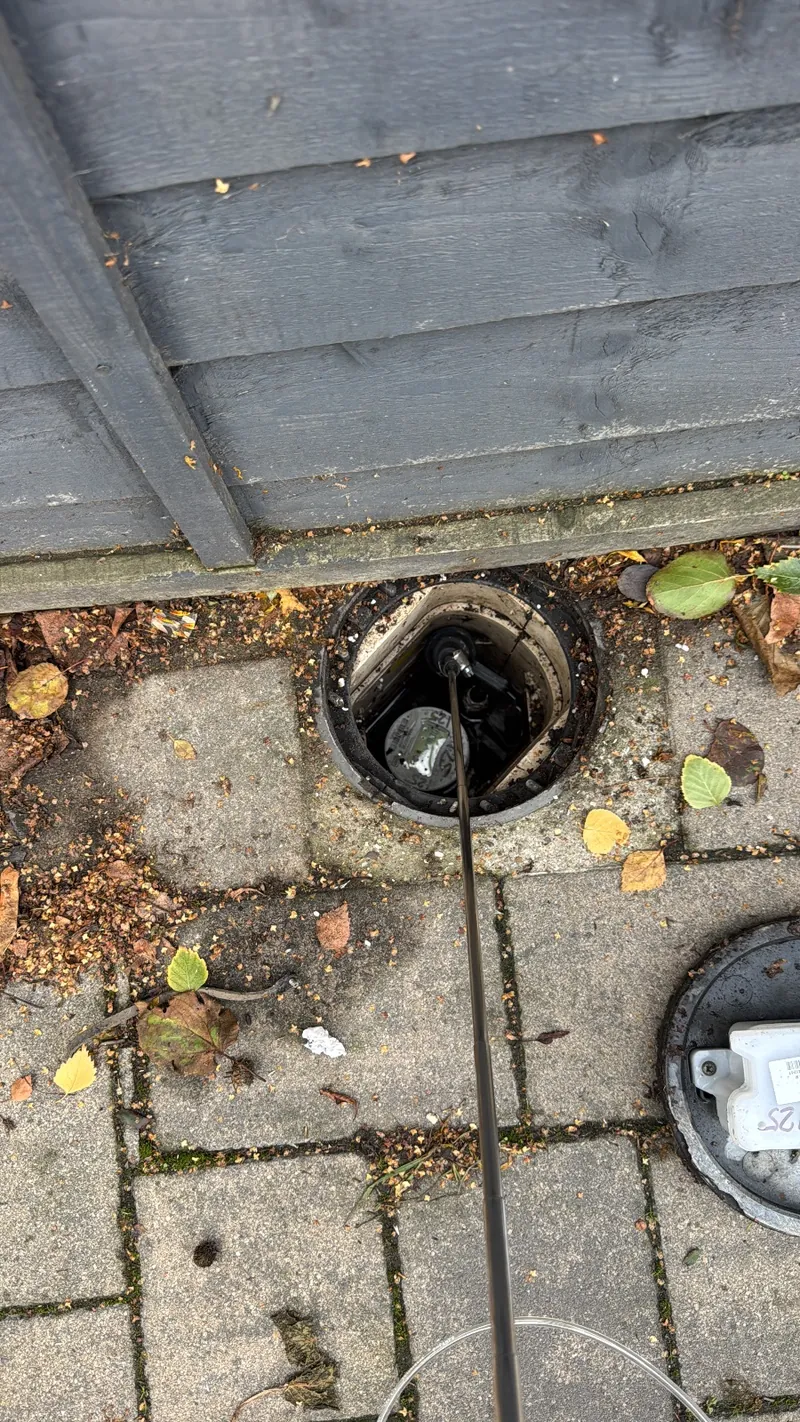
Thames Water says its meters are most often outside, under a small cover near the outside stop valve, and that indoors they are usually under the kitchen sink, sometimes in a basement or a garage. We read that on 24 November 2026. So a garage can hold the meter itself, and a leak near it may be on the supply and not on an outbuilding branch. Where is my water meter helps you find it.
Signs of a leak on the outbuilding supply
- The meter moves when nothing in the house is using water. This is the clearest sign, though it does not tell you where.
- A damp, dark or stained patch on the garage floor, or water at the base of a wall where a pipe enters. Concrete floors can stay wet and look like condensation.
- The sound of running water in the outbuilding with nothing on.
- A wet or soft patch, or a stripe of greener grass, along the line between the house and the outbuilding. Thames Water’s identifying leaks page lists wet or damp patches in the garden in dry weather as a sign of a leak, and it also lists cracks in paving, sinkholes, dirt or air in the water, lower pressure and unexpected high use.
- Low pressure at the outbuilding tap but not in the house, which can point at the branch.
- A higher metered bill with no change in how you use water. See water bill too high: how to dispute it.
None of these proves a leak on its own. Rain, a blocked drain, a leaking gutter or condensation can mimic the first two, and a high bill has many causes. The test below separates them.
Isolate the branch and test it

The idea is to find out whether the loss is on the branch to the outbuilding, or elsewhere. You need a meter, or a way to read the loss, and ideally a valve on the branch.
- Switch off everything that uses water in the house and the outbuilding. Check for a running toilet, a dripping tap and a washing machine that is not finished.
- Close the inside stop valve and record the meter reading. Thames Water describes waiting 30 minutes and reading again. If the reading has not moved, there is no leak between the meter and the inside stop valve. If it has, there is. Our guide on how to do a water meter leak test goes through it.
- If the outbuilding branch leaves before the inside stop valve, closing that valve may not cut it off. Find the branch’s own isolating valve, close it, and repeat the test with the inside stop valve open and the house quiet.
- Compare the two results. If the meter stops moving once the branch is closed, the leak is on the branch or in the outbuilding. If it keeps moving, the leak is elsewhere. See leak between meter and house.
- Note the date and the readings, and photograph the meter.
There are limits. A very slow loss may need a longer test than 30 minutes. A tap that drips in the outbuilding looks the same as a leak in the pipe. A meter that is hard to read, or a house that is not metered, makes the test harder, and how to read a water meter covers the first problem. If you have no valve on the branch, a plumber can fit one, and that is worth doing, whatever the leak turns out to be.
Finding the pipe and the leak
The branch is often buried across the garden, and often not where you expect. We have no source on how deep these branches run. The Water Supply (Water Fittings) Regulations 1999 say a buried fitting needs enough cover to prevent freezing, and that laying underground pipe shallower than 750mm or deeper than 1350mm is a listed work that needs notice to the water company. We read the regulations as made on 25 November 2026. That is about new pipes. Yours may be shallower, particularly if it was laid by a previous owner, so how deep is a water supply pipe in the UK explains why you should not dig on a guess.
- Look for the route. A line of a different colour in the grass, a join in the paving, a cover in the path, a pipe where it enters the garage wall. Where does my water supply pipe run explains how to look.
- Check where it enters the outbuilding. In our experience, leaks cluster where the pipe goes through a wall or floor and at the joints near it.
- Check the pipe type if you can see it. Blue plastic is common underground, and MDPE blue water pipe explained covers how it fails and why it is harder to trace.
- Do not dig along the route or hammer in stakes near it. A nicked pipe can leak months later.
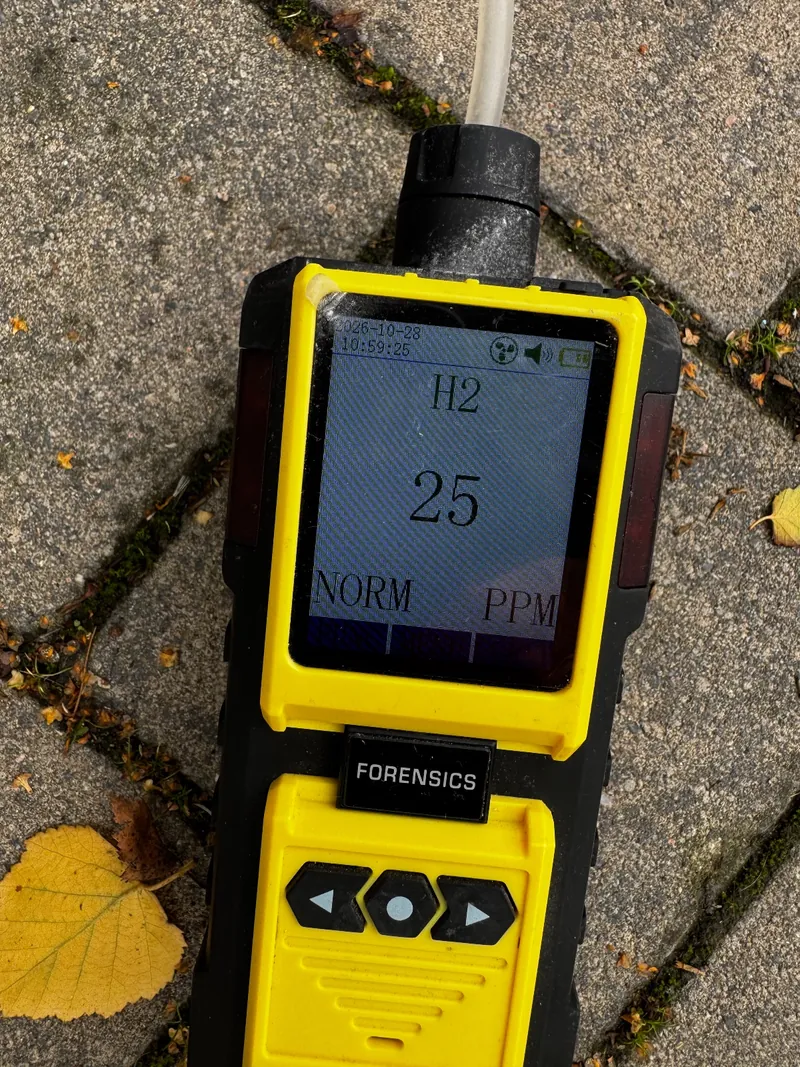
We locate the leak with thermal imaging, moisture mapping and acoustic listening, and tracer gas where those cannot settle it. None is a guarantee. Concrete slabs, hard standing and plastic pipe can all weaken the signal, in our experience, and some jobs give a zone and not a point. We report what we found and what we did not. See non-invasive leak detection and leak under house or slab, which explains the slab case.
Winter, empty buildings and drain-down
An outbuilding is often unheated, and the branch to it is exposed in more than one place: where it leaves the house, where it passes through the garden and where it enters the building. Thames Water’s winter advice from January 2026 names pipes in unheated lofts, garages and utility rooms and on cold external walls as the most at risk. We read that on 25 November 2026.
- If the building is not used in winter, isolating the branch and draining it down is often a better answer than relying on foam. Close the valve at the house, open the tap in the outbuilding and leave it open. How to drain down your water system explains draining.
- If it is used, lag exposed pipes, cover any outside tap and keep the building above freezing where you can. See pipe insulation for lofts, flats and cold spots.
- After a thaw, check the pipe where it enters the building and the floor under any fittings. Thames Water says leaks often appear during a thaw and names the loft and the garage as places to check. See frozen pipes: what to do before they burst.
- If you will be away, see leaving your home empty in winter.
Who fixes it, who pays, and what insurers may say
Thames Water’s page on arranging a leak repair, read on 25 November 2026, says it is your responsibility to arrange repair within four weeks. It says that if a leak on your property is not fixed in that time, it may serve a notice allowing it to do the repair and charge you. It advises checking your home insurance first, and it recommends a WaterSafe approved contractor for hidden or outside leaks. We are independent of Thames Water and we are not on the WaterSafe register, so if that matters to you, check the register at watersafe.org.uk. Pages change, so check the current wording. Who is responsible for a water leak and who owns the water supply pipe cover the wider position.
- Shared supply. Thames Water says the owners share responsibility for the shared part of a supply pipe, and that it does not step into disputes between neighbours. Tell the others in writing and agree the repair before work starts.
- Leasehold garages and lock-ups. GOV.UK says the lease sets out whether the leaseholder or the freeholder handles repairs. It gives no rule on shared pipes, so ask your freeholder or managing agent.
- Rented garages and outbuildings. Under section 11 of the Landlord and Tenant Act 1985, a landlord must keep the installations for the supply of water in working order in the tenancies the Act covers. Tell the landlord in writing, with dated photos.
- Insurance. Policies can treat outbuildings differently from the main house, and we have not opened any policy that says how. Read the wording, check whether the outbuilding and its contents are covered and whether there are conditions for empty buildings. See does home insurance cover water leaks. We cannot say what any insurer will accept.
Repair, and what finding it costs us
Repairs to water fittings should be done in a workmanlike way, which regulation 4 of the 1999 Regulations describes as to a relevant British Standard or an approved method. A joint at the outbuilding wall is one thing. A long run laid shallow, or a pipe that has leaked in several places, may be better replaced, and water supply pipe: repair or replace explains how to weigh it. If a new run is needed, moling vs digging a water supply pipe explains the options, and can I replace my own water supply pipe covers who may do the work.
Tracing a supply pipe or an outbuilding branch is charged at a fixed £450, however long the job takes. Tracer gas is included in the rate. No VAT charged. The hourly rate is not a job price, and the visit length depends on the route and the access. You get a written report with photos. Repairs are quoted separately in writing after detection, never from a price list, because depth, surface and access decide the cost. The pricing page explains how we quote.
To have the leak found, report a leak or ring 020 3961 5444. More guides are in the guides hub.
