
What the rules actually say
Nearly every guide repeats one figure. Here is where it comes from and what it covers. The Water Supply (Water Fittings) Regulations 1999 list the kinds of work that need prior notice to the water undertaker. One entry is laying a water system outside a building at less than 750 mm or more than 1,350 mm below ground level. The text on legislation.gov.uk gives the person doing the work a duty to give notice and not to start without consent, and says the water company has ten working days to respond, after which consent is treated as given. The version we read is the one as originally made, read on 24 November 2026; the current consolidated text was not checked, so use the legislation.gov.uk page to see the live wording.
WaterSafe, the industry register of approved plumbers and installers, gives the same two numbers in its installer FAQ: a minimum depth of 750 mm and a maximum of 1,350 mm for a new water service, with permission from the local water supplier needed to go outside the range. We read that page on the same date.
The regulations also set a purpose. Schedule 2 of the same regulations says any fitting laid below ground level must have a depth of cover sufficient to prevent water freezing in it. So 750 mm is a rule of thumb for “enough cover for frost and damage”, not a measurement of a pipe already in your ground.
New pipes, old pipes and the gap between them
The depth rule applies to pipes being installed now. Most supply pipes in London were not laid yesterday. Many were put in when a street was built, or replaced at various points since, by people working to the rules of their day. So the answer to “how deep is my pipe” is a range with a caveat.
| Factor | Effect on depth | What it means for you |
|---|---|---|
| When it was laid | Older pipes predate the current rules and may be shallower or deeper than 750 to 1,350 mm | Do not assume the modern range applies |
| Obstacles at the time | Pipes are routed around services, foundations and rock or hard ground, and go up or down accordingly | Depth can change along a single run |
| Later groundworks | Patios, drives and extensions can change ground level and cover | The pipe may now be deeper under a raised bed or shallower where ground was lowered |
| Repairs and diversions | A repair or re-route may be at a different depth from the pipe it joins | Do not assume two sections match |
| Entry into the building | The pipe has to rise to the stop valve, so it gets shallower near the house | The most vulnerable point for frost and damage is where it enters |
Treat the general pattern in that table as practitioner experience, not a published survey. We found no primary source that says what typical depths are for existing supply pipes in London, and we are not going to invent one. What we can say is that “750 to 1,350 mm” describes the range for new work, and that a pipe’s real depth has to be found, not recalled.
If you are working out where the pipe goes sideways as well as down, where does my water supply pipe run deals with route, and water supply pipe materials in the UK covers what it is made of, which affects how it is traced.
Why the depth matters to you
Depth changes what you do in four ways.
- Frost. The regulations’ purpose clause is about stopping water freezing in underground fittings. A shallow pipe, or one close to the wall where it enters, is more exposed in a cold snap. See how to prevent frozen pipes and frozen pipes: what to do before they burst.
- Damage. Shallow pipes are easier to hit with a garden fork, a fence post, a drive-in sign or a patio dig. Deep ones are protected from that, and pay for it when something has to be excavated.
- Repair cost and method. A repair at 0.8 m can be a manageable hole. At 1.3 m, in clay or beside foundations, it is a bigger excavation, and the trench sides need supporting. Depth is one of the factors in moling or digging and repair or replace.
- Locating a leak. Most methods work better when the pipe is closer to the surface. A leak in a deep pipe has a longer path to the surface, so the signs can show up further away and the sound at the surface is weaker.
Why you must not dig on a guess

Because the depth is uncertain, any digging based on “it will be about 750 mm down” is a gamble with other services. The Health and Safety Executive’s guidance on avoiding danger from underground services, HSG47, names three parts of a safe system of work: planning the work, locating and identifying buried services, and safe excavation. We read the HSE page on 24 November 2026; it points to the full document for detail on how to do each part.
- Gas, electric, telecom and drain runs can sit in the same ground as the water pipe, and some are shallower than you would think.
- The fault is rarely at the surface patch. Water follows bedding and gaps, so digging at the wet spot can miss the leak entirely and leave you with a hole you must pay to reinstate.
- A pipe that has been located and marked can be exposed with hand tools in a small area. A pipe that has not been located is what spades and mini diggers go through.
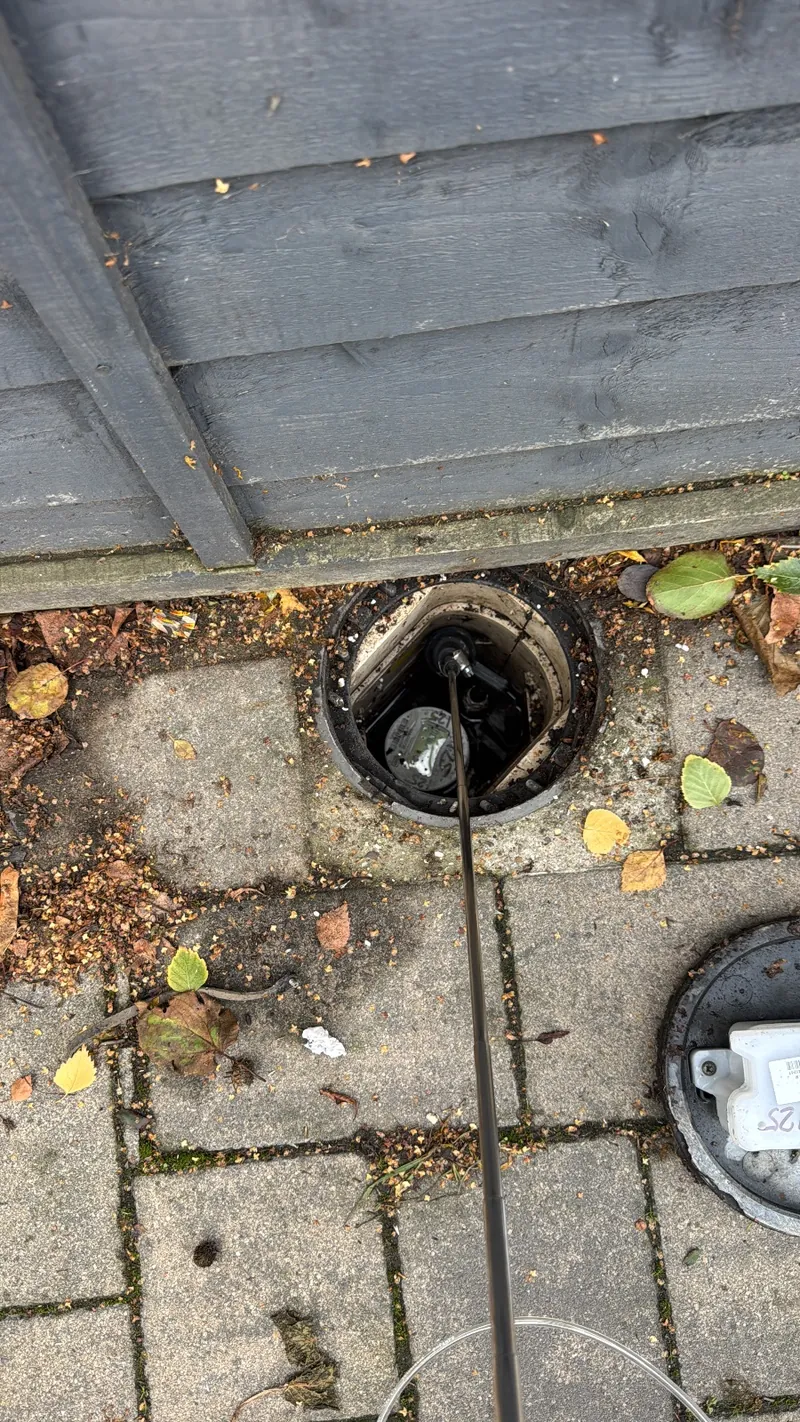
If you want to find your pipe, the safe order is: identify the route (meter, stop valve, the point it enters the house), locate it with equipment, mark it on the surface, and only then open the ground at the point you need. A tracer wire laid alongside a plastic pipe, if there is one, is what lets equipment follow it; an old plastic pipe with no wire is harder, and part of why a survey cannot promise to follow every pipe.
How the depth is actually found
There are three practical ways, and none is perfect.
| Approach | How it works | Limits |
|---|---|---|
| Electronic pipe locator | A receiver follows a signal on the pipe or a trace wire. Many units can give an estimated depth at the point you are standing over. | The depth shown is an estimate and can be off if there is interference. Plastic pipe with no wire gives nothing to follow. |
| Trial hole | A small hole dug by hand at the located point, to see the pipe and measure to it. | Accurate at that spot only. Costs a reinstatement. Depth can differ ten metres on. |
| Records | Ask the water company or previous owners for service records or surveys. | Records for older properties can be missing or approximate. Check with the water company and treat what you are given as a guide. |
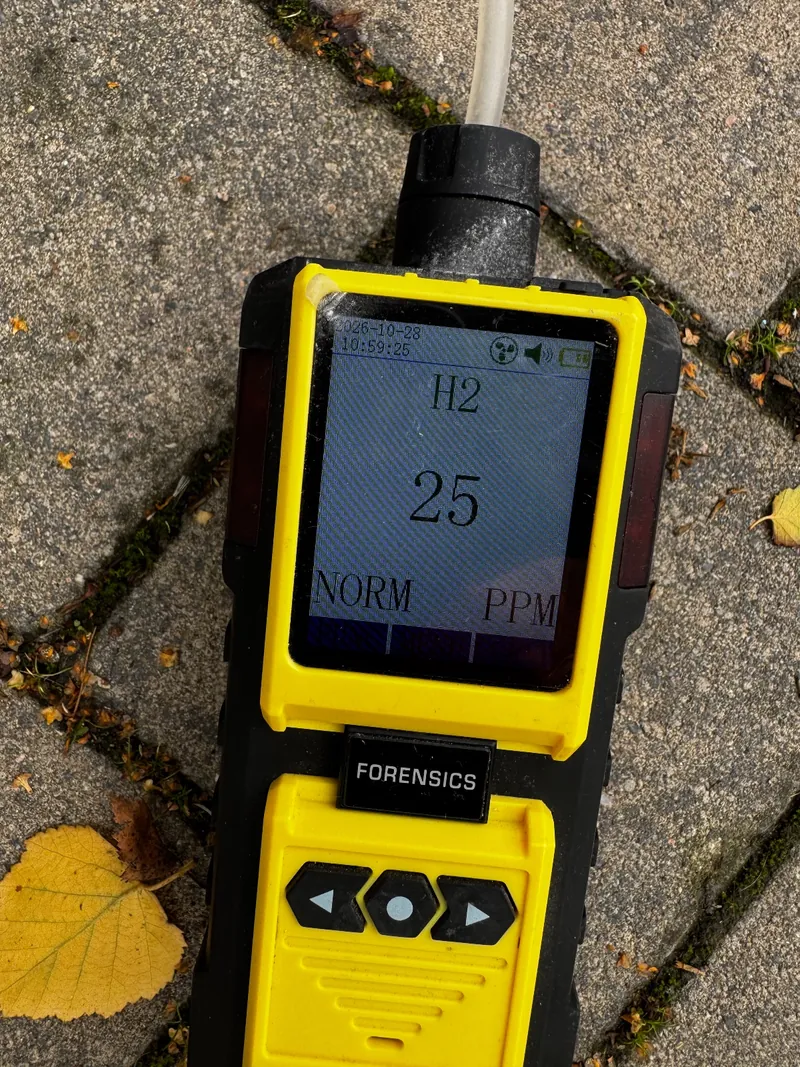
In a leak survey, depth is not the main point. The engineer follows the route, listens, and if needed puts gas into the pipe; depth is a by-product that helps decide whether a small access hole is enough. We can say what the equipment reads on the day; we cannot promise it is exact. Details of the process are in what happens on the day.
If a pipe has to be replaced: depth and notice
Replacing a pipe means choosing a new depth. If you intend to go outside 750 to 1,350 mm, the regulations as originally made require notice to the water undertaker first, and WaterSafe says permission is needed. In the as-made text, a like-for-like leak repair on an existing fitting is not among the listed operations, but replacing a run or laying a new one is a different matter, and the current wording was not checked. Ask your water company, and ask the contractor to tell you in writing what depth will be used.
Whoever does the work, Thames Water’s page on arranging repairs says to ask for a certificate of water regulations compliance afterwards. For who may do what, and for what a replacement involves, see can I replace my own water supply pipe and water supply pipe replacement. Under a drive or patio, water leak under a driveway covers the surface problem.
We are not on the WaterSafe register, which is the industry list of approved plumbers and installers. Thames Water recommends WaterSafe approved contractors for hidden or outside leaks, and you are free to use any competent contractor.
What finding the pipe and the leak costs
If your reason for asking is a suspected leak, mains and supply pipe tracing is charged at a fixed £450, however long the job takes. How long the run is, how easy the pipe is to isolate and how many methods are needed change the time on site, not the price. Tracer gas is included in the price. No VAT charged.
Repair or replacement is quoted separately in writing once the pipe and fault are located, because depth, ground and surface all change the job. See pricing and how we price. If you suspect a leak, report a leak with what you have seen, or ring 020 3961 5444; the guides hub has the rest of the supply pipe series.
