
What the test shows, and what it cannot
A water meter counts every litre that passes through it. If water moves through it while nothing in your home is using any, something is letting it out. The test below asks the meter that question under controlled conditions.
It has limits, and they matter. Thames Water’s version of the test, read on 24 November 2026, says that if the two readings differ you have a leak between the meter and the inside stop valve. It says if they match you do not have a leak. We would put it more carefully: matching readings mean no leak on the stretch of pipe the water travelled through. They do not cover the water company’s side of the meter, or a leak past the closed valve inside the house.
Below you get the protocol, a reading log, a table that turns a few litres into litres per hour, a guide to the flow indicator and what each result means. If you have not found your meter, start with where is my water meter. For what a leak between meter and house involves, see water leak between the meter and the house.
Before you start

You need a pen or notes app, a phone with a clock, a torch, and a flat-bladed screwdriver if your meter box has an inspection cover. You also need to know where two things are: the meter and the inside stop valve.
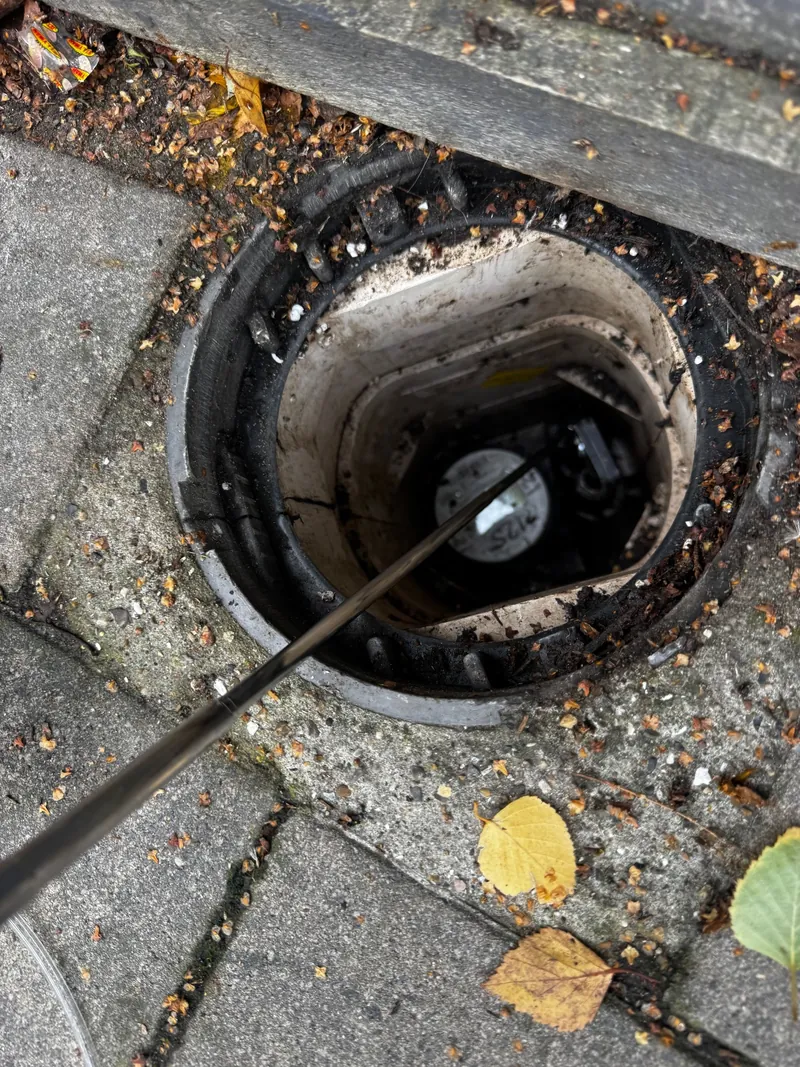
Thames Water says meters are most often outside, under a small cover in a driveway, garden or footpath near the outside stop valve, and sometimes in a shared pit or further away. Indoors, a meter is usually under the kitchen sink near the inside stop valve, and occasionally in a basement or garage. Match the serial number to your bill so you know it is yours.
Pick a moment when nobody is using water, such as first thing in the morning or when the house is empty. One shower or flush during the test spoils it.
Check that the inside stop valve closes. Thames Water says it is usually under the kitchen sink and turns clockwise without force. Our guide to how to turn off your mains water covers a valve that will not move. One that does not close fully makes the test unreliable.
The test, step by step
- Switch off or stop everything that uses water. That means dishwasher, washing machine, taps, showers and baths. Check that no toilet is refilling, and that nobody is about to flush.
- Think about the less obvious users: a water softener, a fridge ice-maker, garden watering, a heating filling loop. Switch them off or note them on the log.
- Go to the meter and read it. Write down every digit, including the red ones, and the time. Take a phone photo of the dial as well.
- Check the flow indicator, described below. If it turns with everything off, that is already a strong sign of a leak.
- Close the inside stop valve by hand, clockwise, until it stops. This isolates your home’s internal plumbing from the supply pipe.
- Wait 30 minutes. That is the interval Thames Water gives. Do not use any water in that time.
- Read the meter again, write down every digit and the time, and photograph it.
- Subtract the first reading from the second. Record the difference in litres, using the conversion below.
- Reopen the valve slowly and run a tap until the air clears. Leave the valve fully open.
The Consumer Council for Water adds a comparison with the valve open. With appliances off, if the dial still moves you may have a leak. Close the inside stop valve and check again: movement then points to the supply pipe outside the house. If it stops, reopen the valve, and movement with the valve open points to a leak inside. Doing both checks takes about an hour and narrows the location.
Some sites quote an hour. We use Thames Water’s 30 minutes because it is the water company’s own method. For a very slow leak a longer gap shows more, so, as our own suggestion, repeat the test with an overnight gap if 30 minutes shows nothing but your bill or damp patches say otherwise.
The reading log

A log turns a feeling into evidence. Thames Water’s allowance form asks for meter readings and a description of the leak, so it is also paperwork you may want later. Keep one line per reading.
Copy the columns below into a notes app or onto paper: time, valve position, every digit on the meter, the change in litres, and who was home.
Here is an invented example. It is not from a real property. The meter shows cubic metres in the black digits and fractions of a cubic metre in the red digits, which is common on UK meters, so one thousandth of a cubic metre is one litre. Check the markings on your own meter, because displays vary.
| Time | Valve | Reading (m³) | Change (litres) | Notes |
|---|---|---|---|---|
| 06:40 | Open, everything off | 01482.317 | Flow indicator turning slowly | |
| 06:45 | Closed | 01482.317 | 0 | Valve shut by hand |
| 07:15 | Closed, 30 minutes on | 01482.334 | 17 | Reading moved with valve closed |
| 07:20 | Open again | 01482.334 | Test ends |
In that example 17 litres passed the meter in half an hour with the inside valve shut. That points to a leak between the meter and the valve. The next table shows what it adds up to.
Turning a few litres into a number that means something
One cubic metre is 1,000 litres. Because the test runs for half an hour, doubling the change gives litres per hour, and multiplying that by 24 gives the daily figure if the leak ran constantly. Real leaks vary with pressure and time of day, so treat the daily figure as a rough scale, not a prediction.
| Moved in 30 minutes | Per hour | Per day | What it looks like |
|---|---|---|---|
| 1 litre | 2 litres | 48 litres | A very slow weep. Easy to miss without a log |
| 5 litres | 10 litres | 240 litres | Around Thames Water’s “small trickle” scale |
| 10 litres | 20 litres | 480 litres | More than a typical leaking toilet |
| 17 litres | 34 litres | 816 litres | The invented example above |
| 50 litres | 100 litres | 2,400 litres | A clear, running leak |
| 170 litres | 340 litres | 8,160 litres | Close to Thames Water’s “constant flow” scale |
For scale, Thames Water’s identifying-leaks page gives some reference points per day: up to 200 litres for a small trickle, about 400 for an average leaking toilet, about 600 for rippling water and around 8,000 for a constant flow. Its yearly money figures look out of date against its 2026-27 metered charges, so we publish litres only. Multiply cubic metres by the combined rate on your latest bill to price a leak yourself.
Reading the flow indicator
Many meters carry a small dial, star or triangle on the face that turns when water passes, even at flows too small to move the main digits quickly. Designs differ between makes, so look at yours with a torch rather than trusting a description.
- Turning with everything off and the valve open: water is moving somewhere, whether through a leak or something you forgot, such as a refilling cistern.
- Turning with the inside stop valve closed: water is moving between the meter and that valve.
- Still when the valve is closed, turning when it is open: the leak is inside the home, past the valve.
- Still in both cases: nothing is moving at this moment. A leak that only runs at certain times, for example when a toilet cistern drops and refills, can hide from a single check.
The indicator is a quick check, not a measurement. Use it to decide whether a full 30-minute test is worth running, and read the digits for the number.
Reading the result
| What you saw | What it suggests | What to do next |
|---|---|---|
| Reading moves with the inside valve closed | A leak on the pipe between the meter and the inside stop valve, which is normally the property owner’s supply pipe | Read leak between the meter and the house, then arrange a trace |
| Stays still with the valve closed, moves with it open and everything off | A leak inside the home: a toilet, a hidden pipe, a tank, a heating loop | Check toilets (below), then call a plumber or book a leak detection survey |
| Stays still in both states | No leak on that stretch during the test | If the symptoms continue, test again at a different time, or look at damp and the heating system |
| Moves in both states, at different speeds | Possibly two leaks, or a leak plus an appliance | Isolate what you can, repeat the test, then get a survey |
| Moves only during the first minutes | A cistern refilling, a heating loop topping up, or air working out of the pipes | Wait for the system to settle and repeat |
Note the wording in the first row. The pipe between the meter and the inside stop valve is generally the owner’s responsibility. Thames Water says the supply pipe from the property boundary into the home, plus all plumbing inside, is generally the property owner’s. It also says public pipes under roads and pavements are its responsibility. See who owns the water supply pipe for the full picture.
The test does not tell you how far along the pipe the leak is, what it is made of, or how deep it runs. It tells you which of a few possible zones to investigate. Locating the point itself needs methods such as acoustic listening, tracer gas or thermal imaging. Our mains and supply pipe trace page explains how we do that.
Rule out the false alarms first
Most failed tests turn out to be something ordinary. Before you call anyone, go through these.
- A leaking toilet. Thames Water’s test: wait 30 minutes after a flush, dry the back of the pan with toilet paper, lay a fresh dry sheet there, and leave it for at least three hours, ideally overnight, without using the toilet. If the paper is soggy or torn, the toilet is leaking. To check the cistern, mark the water level and look again after 10 minutes. A drop points to the flush valve. Thames Water puts a leaking toilet at around 200 to 400 litres a day and says about one household in 20 has one.
- Water-using extras. Ice-makers, softeners, garden irrigation and an outside tap left dripping all move the dial.
- A neighbour on a shared supply. Where one supply pipe feeds several homes, readings can be affected by use elsewhere, and the shared section is a shared responsibility. Thames Water says it does not step into disputes between neighbours.
- Someone running water. It sounds obvious, but a shower upstairs ruins more tests than any leak does.
- A faulty or misread meter. Check the digits against your photo. If a meter appears to count while the pipes are definitely still, tell the water company.
Higher bills are not proof of a leak on their own. Thames Water lists extra occupants, weather and renovations alongside leaks as reasons a bill goes up, and says estimated bills are adjusted when a real reading arrives. See why is my water meter reading so high and what runs your water bill up the most.
What to do after a positive test
- Act soon. A few litres an hour sounds small, but it runs all day, and a leak on an underground pipe can get worse without warning.
- Save your log and photos. They show when you found the problem and how big it looked.
- Check your insurance. Thames Water advises checking home emergency or buildings insurance before arranging a repair, since some policies cover supply pipe leaks. Policies differ, and cover for finding a hidden leak is often tied to damage from escaping water, so read your wording.
- Get the leak located before you dig. Digging along a guessed route costs more than a survey, and a trace shows whether the leak is under paving, a lawn or a slab.
- Arrange the repair in good time. Thames Water’s leak allowance page says to fix a confirmed leak within four weeks, and to claim within three months of the repair date. Those are the figures on its page as we read it on 24 November 2026, and they can change, so check the current page before you act. The allowance is for metered customers.
- Keep the repair invoice. For the allowance, Thames Water asks for the plumber’s details and invoice, or a Thames job number if it did the work, plus meter readings and a description of the leak. We cannot say whether it will accept any particular report, so ask it.
A trace by us costs a fixed £450, however long the job takes for mains and supply pipe leak detection. Tracer gas is included in the price. We charge No VAT charged, and a repair is quoted in writing once the leak is located, since every repair differs. Full rates are on the pricing page. To book a trace, report a leak.
If the result is unclear, our guides on water meter leak repair and signs of a leak underground cover the next layer, and the leak allowance evidence checklist lists what paperwork to keep.
