
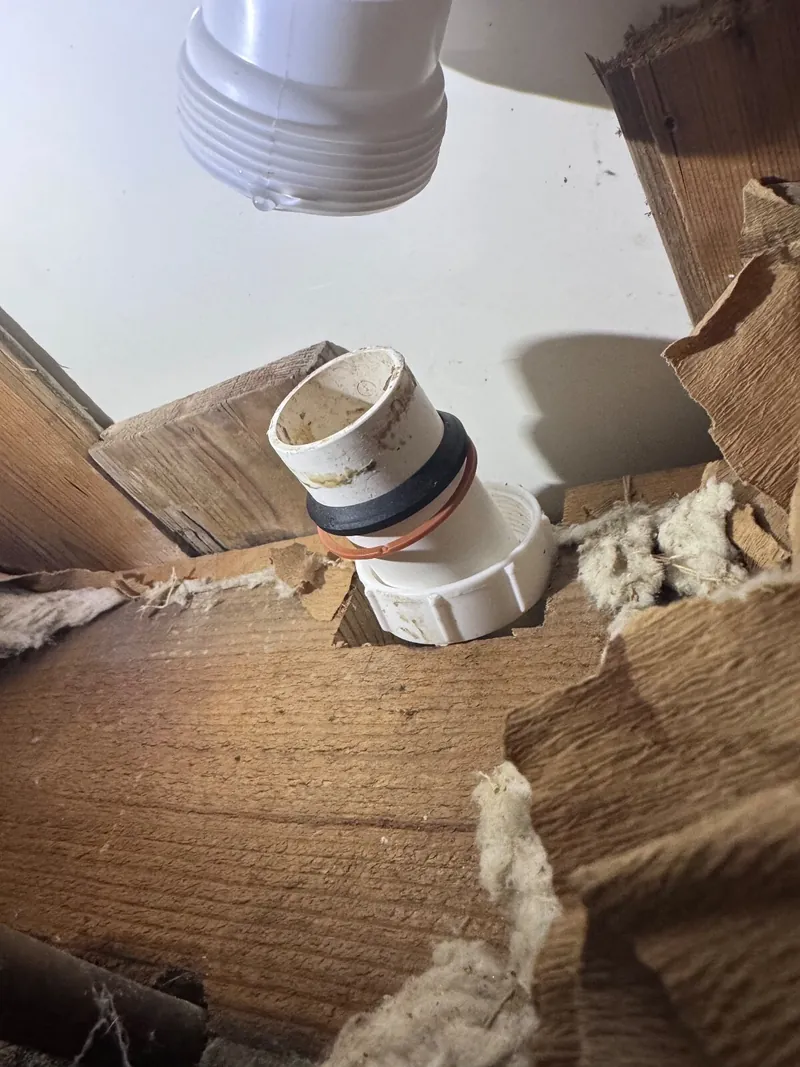
What a pan connector is and why it leaks
The pan connector is the short fitting that joins the back of the toilet pan to the soil pipe in the wall or floor. It is usually a flexible rubber or plastic sleeve, sometimes a rigid angled piece, and it has to hold a seal while the pan is flushed, sat on and cleaned around. It carries waste water, not mains water, so a leak here does not run all day. It shows up when the toilet is flushed.
That is why this fault is easy to miss. A small weep at the joint may only release a little water at each flush, and the toilet looks and sounds normal. The first sign is often something indirect: a damp patch on the floor beside the pan, a stain on the ceiling below in a flat, a musty smell in the bathroom, or lifting flooring around the base of the toilet.
In our experience the common reasons for a leaking connector are an old rubber sleeve that has hardened or split, a pan that has shifted slightly so the connector no longer sits straight, a soil pipe that is out of line, or a joint that was never fully seated when it was fitted. These are practitioner observations, not a complete list, and a particular toilet may have something different going on.
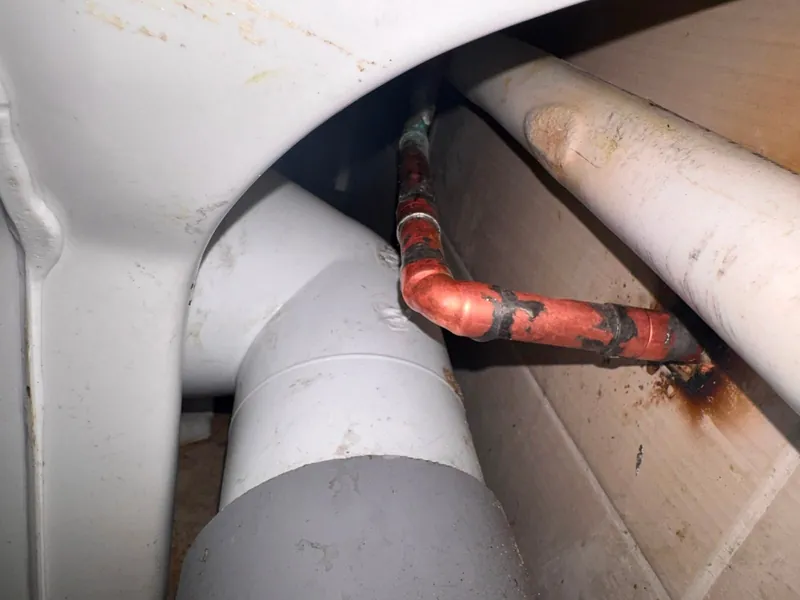
Staining like the pipe above is a clue that an area has been wet at some point. It does not tell you by itself whether the water came from the connector, a nearby supply pipe or somewhere else, which is why the source has to be confirmed rather than assumed.
Signs that point to the connector
None of these proves a connector leak, but several together make it a sensible first suspect.
- Water or dampness at the back or side of the pan base that appears after flushing and dries out in between.
- A stain on the ceiling of the room below that gets worse on days when the toilet is used more.
- A smell around the toilet that is stronger after a flush. Waste water has a different smell from clean water.
- Floor covering that is soft, discoloured or lifting around the pan, or a wet skirting board behind it.
- A water meter that does not move when nothing is running, even though you can see damp. A steady meter movement points towards a supply pipe or cistern instead. The water meter leak test explains how to check this.
Because the connector carries waste, the damp can look like a supply leak but behave differently. A supply leak keeps going whether or not anyone uses the toilet. A connector leak tends to follow the flush. That difference is a clue, not a rule. A cistern or a supply connection can leak at the same spot, so the diagnosis has to be made by looking and testing.
Safe checks before anyone arrives
These need no tools and do not open anything up.
- Dry the floor around the base of the pan and the back of the pan with a towel or kitchen roll.
- Lay a dry sheet of kitchen roll flat against the floor at the back of the pan, where the connector enters the wall.
- Flush once and watch the joint behind the pan with a torch. Do not put your hand into the joint.
- Look at the paper. Wet paper straight after a flush, with the cistern and supply connection still dry, suggests the waste side.
- Photograph what you find, with a note of the time, so there is a record for the visit and for any landlord, managing agent or insurer.
If the cistern or its supply connection is wet, or the floor is wet before you have flushed, you may be looking at a different fault. Our page on toilet leaks and running cisterns covers those, and running toilet fixed in one hour covers the cistern side of a first-hour visit.
What we do in the first hour
The first hour costs £100. On a suspected connector leak a visit often runs like this.
- We ask when the damp appears, whether it follows the flush, and whether anything has been fitted or moved near the toilet.
- We look at the joint while the toilet is flushed, with a torch and a small mirror where the space is tight, and check whether the pan sits level and square to the wall.
- We use a moisture meter around the pan, the skirting and the floor to see how far the damp has spread and whether it is still active.
- We isolate and test the supply side where the leak is not clearly from the waste, so that the cistern, its connection and the pipework are ruled in or out.
- We tell you what we think is leaking, what we could not check and why, and we write up the repair with a quote.
The standard rate includes tracer gas, acoustic detection, thermal imaging, an endoscopic camera inspection, a trace and access report for your insurer and a written quote for the remedial works. On a pan connector job the moisture meter and a visual look usually do most of the work. Other methods only come out when something points away from the toilet.
Sometimes the supply pipes next to the toilet need ruling out. A sealed pipe system can be tested with tracer gas, which is a hydrogen and nitrogen mix released into the pipework and picked up at the surface by a detector. We explain when that is worth doing on the non-invasive leak detection page.
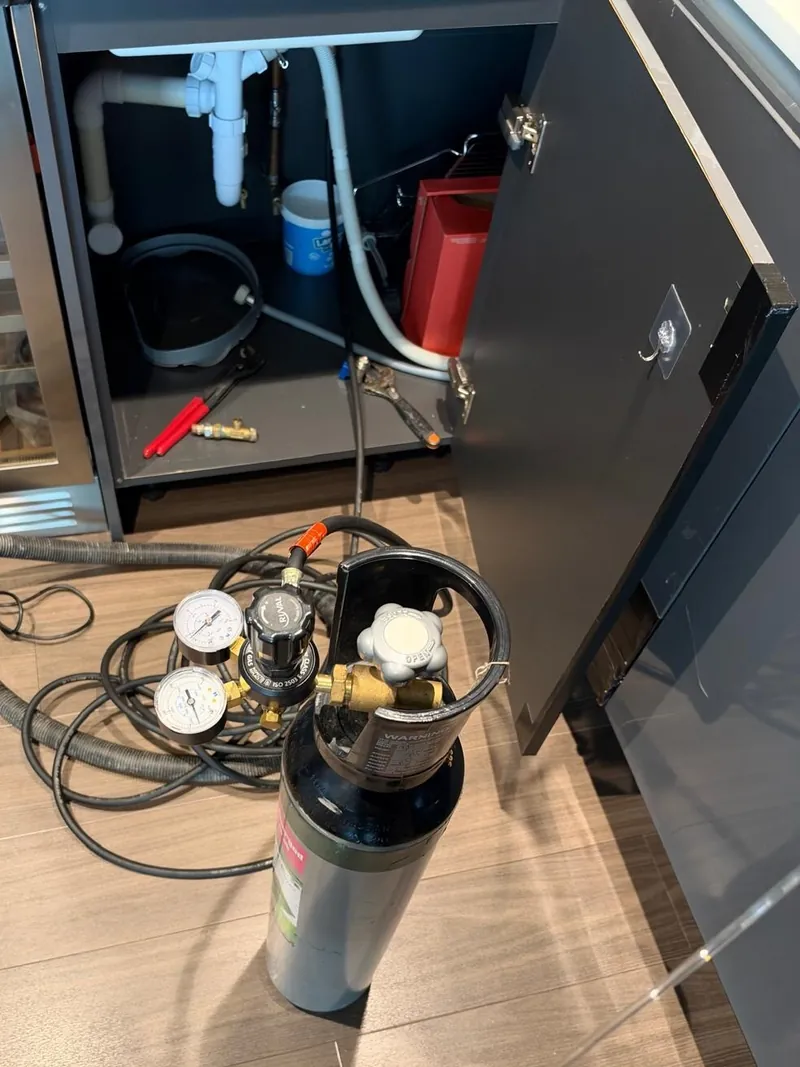
The photo above shows the sort of equipment used for a tracer gas test. It is from a different room and a different job, and it is here to show the kit, not the toilet. Most connector jobs never need it.
What a first hour can achieve
There are four outcomes we aim for in a first hour, and they do not always all happen.
| Outcome | What it means for you |
|---|---|
| Find it | We see water at the connector joint, or the damp pattern points to it clearly. |
| Confirm it | We flush and watch, and we rule out the cistern, the supply connection and nearby pipework, so we are not guessing. |
| Quote the fix | You get a written repair quote, set out in parts and work, so you can accept it or take it to another plumber. |
| Sometimes fix it | Where the connector is accessible, the right part is to hand and you approve the quote, the repair can sometimes follow in the same visit. |
We are plumbers as well as leak specialists, so we can carry out the repair once you approve the quote. If you would rather use your own plumber, the written finding is yours to hand over.
To put it in context, our case study of a toilet leak that only showed when flushed describes a job where the connector was one part of a wider check. It is a single job in London, and every property is different.
What usually needs more than an hour
We would rather say this now than at the door. A pan connector job may need longer, or a second visit, when:
- The soil pipe is out of line, cracked or bowed, so a new connector alone will not hold.
- The toilet is fixed with a concealed frame, a boxed-in cistern or tiled-in surround, and reaching the joint means taking something apart.
- The pan is fixed to the floor and cannot be lifted without disturbing the floor covering or the seal.
- The floor is wet or soft and the damp may have spread into the structure. Drying and repairing floor and ceiling is a separate job from fixing the leak.
- Water is also coming from another source. A damp flat can have more than one leak, and the tests for each take time.
- The toilet is in a rented flat or a building with shared drainage, and the repair needs consent or a managing agent. See who is responsible for a water leak.
For a leak that is hidden or is not at the toilet at all, find a hidden leak in one hour describes what the first hour of detection can do, and the leak detection survey page covers longer visits.
If the toilet connector turns out to be a minor part of a bigger picture, such as a shower waste or a pipe elsewhere, the sibling pages on a waste pipe leak under a shower and pressure testing pipework describe those checks.
What it would cost under the pricing
Standard leak detection is £100 for the first hour, then £150 an hour, billed in half hours after the first hour. Everything is included: tracer gas, acoustic detection, thermal imaging, an endoscopic camera inspection, a trace and access report for your insurer and a written quote for the remedial works. No VAT charged, and there is no parking charge.
| Time on site | Total |
|---|---|
| 1 hour | £100 |
| 2 hours | £250 |
| 3 hours | £400 |
These are totals worked out from the rate, not the price of any past job. A typical survey that runs two and a half to three hours is £325 to £400. We call you before the survey goes past 3 hours, so you decide before it grows. No find, no fee: if a leak is present and we do not find it, you pay nothing.
The repair is not in those totals. A new connector, a re-seated pan or a soil pipe repair is quoted separately in writing after we have found the leak, with the parts and the work set out. We do not publish repair prices on the site because the fix depends on what is behind the pan. The pricing page shows the full rate card, and what leak detection does and does not include lists the boundaries.
Keeping a record for a landlord, agent or insurer
A slow waste leak under a toilet is the sort of fault that can damage a ceiling in the flat below before anyone upstairs notices. If another household is affected, a dated written finding helps everyone agree where the water came from.
Our report says what was tested and what each test showed, including the checks that came back clear, with photographs. You can see the layout in the sample report. We do not say what an insurer or a landlord will do with it. If you are thinking about a claim, the escape of water claim checklist sets out what to gather, and the guidance for landlords and leaseholders covers the questions that are particular to rented and leasehold homes. Check your own policy wording before you act.
When to call
Call when:
- there is damp beside the toilet that comes and goes with the flush
- a ceiling below a bathroom is stained and you need the source confirmed
- the flooring around the pan is lifting and you are not sure why
- you manage or let a property and need a written finding rather than a guess
Book through report a leak or call 020 3961 5444. We confirm the rate and the time before anyone travels. The wider offer is leak detection for £100 for the first hour, the other jobs are in leak jobs that can be solved in one hour, and the guides cover the rest.
