

What a hidden leak looks like
A hidden leak is water escaping somewhere you cannot see: inside a wall, under a floor, above a ceiling or in the ground. You rarely see the leak. You see what it does. A stain that grows on a ceiling. A patch of paint that blisters or a skirting board that lifts. A floor that feels cold or damp. A smell that comes back after cleaning. A meter that moves when every tap is off. A bill that climbs without a change in how you live.
The difficulty is that water travels. It follows gaps, joists and pipe runs, so the place where it shows is often some way from where it starts. A ceiling stain can sit under a bathroom, a kitchen, a heating pipe or a roof. That is why opening up where the damp appears is a poor first move. You can lose a floor and still be in the wrong place.
Not every damp patch is a leak. Condensation, rising or penetrating damp, a blocked gutter and a failed seal around a bath can all look similar. A good survey rules those in or out. That is a practitioner view, and we say so in the written result when something is not a plumbing leak.
Safe checks you can do first
- Do the meter check. Switch off appliances, close the inside stop valve, take a reading, wait 30 minutes and read again. Thames Water says that if the reading has moved, the leak is between the meter and the inside stop valve. Our guide to the water meter leak test goes through it.
- Now repeat it with the inside stop valve open and every tap and appliance off. If the meter moves only then, the leak is on the pipes inside.
- Photograph the damp with a date and a coin or a ruler for scale. Check again in a few days. A patch that grows is more useful evidence than a patch that stays still.
- Note when it changes. Does it get worse when the heating comes on, after a shower, when a washing machine runs, or after rain? The pattern separates a plumbing leak from weather damp.
- Look at the boiler pressure gauge, if you have one. A sealed heating system that keeps losing pressure points to a heating leak, which is a different fault.
Do not dry out, paint over or open up the damp area before we see it. We need to see where the water has been. If water is flooding the property, turn off the inside stop valve and read what to do in the first hour of a mains leak.
To spot the signs earlier, see signs of a mains water leak and signs of a leak underground.
What we do in the first hour
The first hour costs £100. On a hidden leak, the aim is to narrow the search quickly and to avoid guessing. Usually, though that depends on the job, the hour goes like this.
- A short briefing on what you have seen, where and since when, and where the stopcock, meter and boiler are.
- A meter and isolation check, to tell whether the water is leaving the supply pipe or the pipes inside.
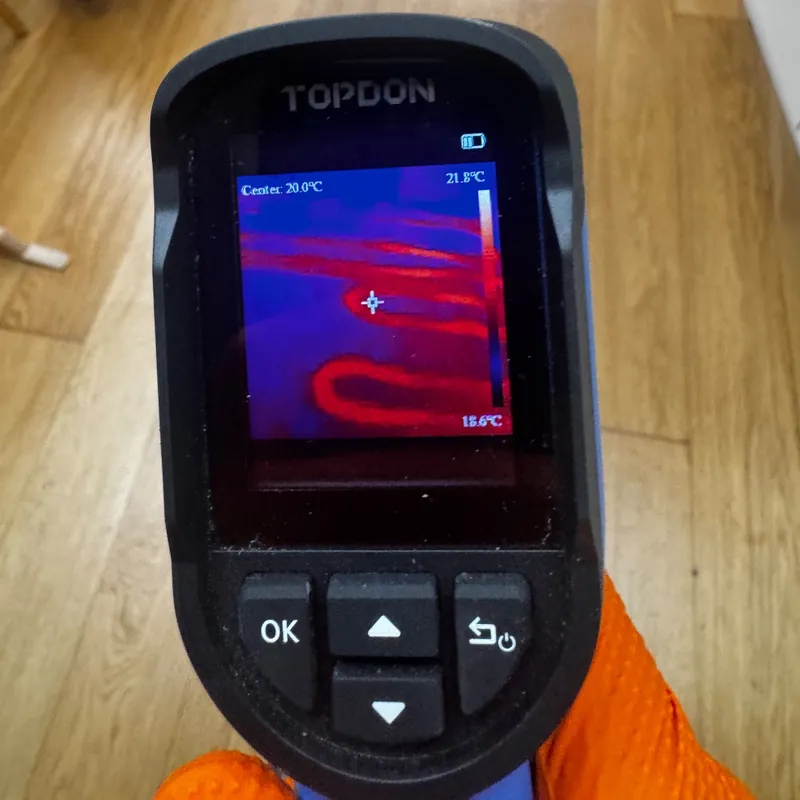
- Thermal imaging and moisture readings across the damp area and the rooms around it, to see where the wetness is highest and which way it has travelled.
- Isolation of sections where valves allow, so we can tell which branch of pipework the water is leaving.
- Listening with acoustic equipment on a pressurised pipe where one is suspected.
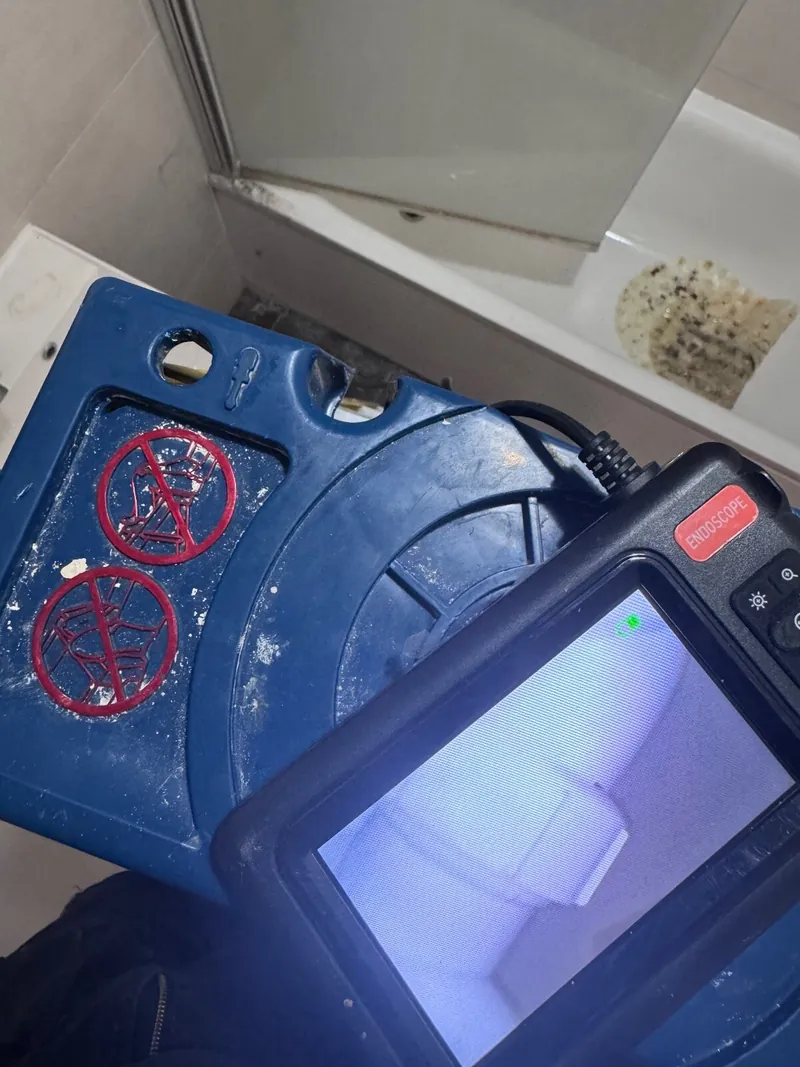
- Tracer gas or a camera inspection, where the earlier checks point to a spot that needs confirming.
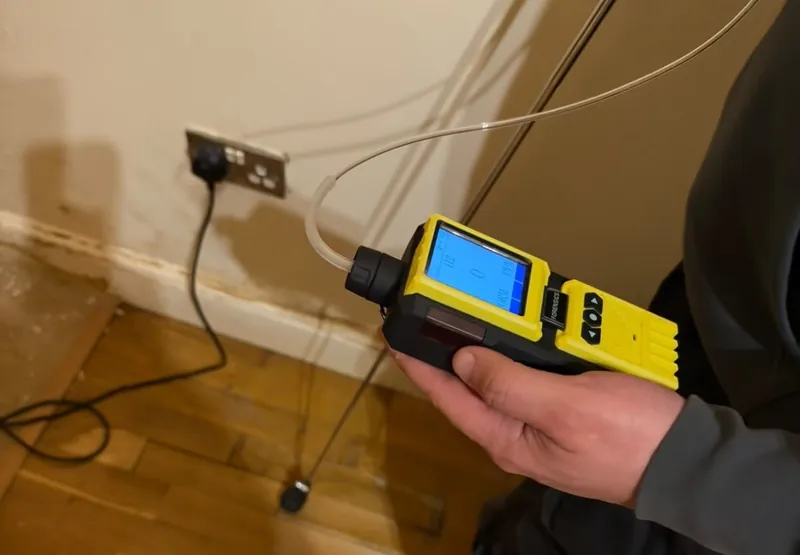
One reading is a lead. Two methods that agree are a finding, and we only mark a position when they do. If the hour ends with a lead and not a finding, we say so, and we explain what the next step would be and what it would cost, before you decide whether to go on. What happens on the day describes a full visit.
The standard rate includes tracer gas, acoustic detection, thermal imaging, an endoscopic camera inspection, a trace and access report for your insurer and a written quote for the remedial works. There is no separate charge for the gas or the camera. Our page on non-invasive leak detection explains each method and its limits.
What a first hour tends to find, and what it tends not to
| Situation | Often a first hour can | Often needs longer |
|---|---|---|
| Stain under a bathroom | Show whether the water is on the supply or the waste, and narrow it to a wall or a floor area | Confirm the exact point under a tiled floor |
| Meter moving, everything off | Say whether the leak is inside or on the buried supply pipe | Trace a buried pipe, which is a separate fixed price job |
| Damp wall with heating on | Show whether a heating pipe is involved | Pressure-test and trace the pipework |
| Smell or damp in a cupboard | Find a failed hose or joint if it is accessible | Find a joint in a boxed-in run |
| Several symptoms at once | Rank the likely sources | Locate each, which usually takes more than one hour |
These are patterns of the kind of search we do, not a record of past jobs. The ability to find a leak quickly depends on access and on how many leaks there are. We do not promise that a leak is found in an hour.
What usually needs more than an hour
- Leaks that only run when a particular tap, appliance or the heating is on.
- More than one leak at the same time.
- Pipes under a finished floor, behind tiling or in a boxed-in section, where access limits the methods.
- Heating leaks, where the system has to be running and the water is hot, and underfloor heating where the loops are hidden.
- Leaks on the buried supply pipe between the boundary and the house, where the detection is a trace on the ground and the price is a fixed £450, however long the job takes.
For the buried case, see supply pipe leak trace and repair, leak between meter and house and leak under house or slab. A damp problem that is not a leak is covered in moisture mapping and damp diagnosis.
For a sense of how long a full survey takes, read how long leak detection takes.
What it would cost under the pricing
Standard leak detection is £100 for the first hour, then £150 an hour, billed in half hours after the first hour. No VAT charged, and there is no parking charge. If the first hour answers the question, the survey part is £100.
| Time on site | Total |
|---|---|
| 1 hour | £100 |
| 1.5 hours | 175 pounds |
| 2 hours | £250 |
| 2.5 hours | 325 pounds |
| 3 hours | £400 |
| 4 hours | 550 pounds |
A typical 2.5 to 3 hour survey is £325 to £400, and that is the realistic expectation for a hidden leak that is not obvious. The totals are worked out from the rate, not taken from past jobs, and they are a guide, not a cap. We call you before the survey goes past 3 hours, so you decide whether to go on. A buried mains or supply pipe leak is a fixed £450, however long the job takes.
Repairs are not in these prices. Once the leak is found, you get a written quote for the remedial works, and the repair is quoted separately. See the pricing page for the whole rate card.
When to call
- a stain or damp patch has come back after drying
- the meter moves with everything off and the toilet and taps are not the cause
- a bill has risen without a change in how you live
- you need a written finding for an insurer, a landlord or a managing agent, see leak detection report for an insurance claim
- you are buying a flat or house and want the plumbing checked first, see pre-purchase leak surveys
Book through report a leak or call 020 3961 5444. We confirm the rate and the time before anyone travels. The wider offer is leak detection for £100 for the first hour, the other one hour jobs are on leak jobs that can be solved in one hour, and the guides cover the rest.
No find, no fee: if a leak is present and we do not find it, you pay nothing. That includes the first hour. The survey ends with a written report with photos, and the report says what was found and what was ruled out.
