

What a pressure test is
A pressure test is the simplest way to ask whether a pipe is sound. A section of pipework is closed off at both ends, a gauge is fitted, and the section is brought up to a test pressure. If the needle stays where it is, the section is holding. If it drops, the section is losing pressure, and something in it is leaking.
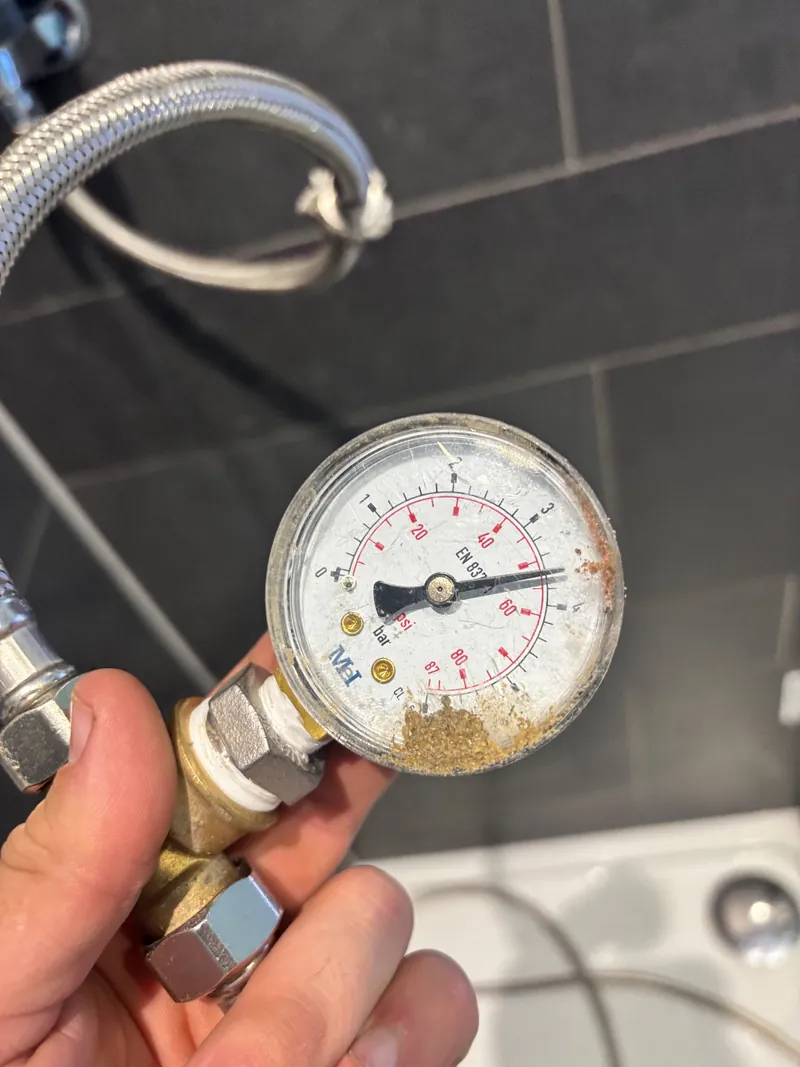
The test pressure and the time it is held depend on the pipework and on what it is made of, and we agree both before starting. We do not use a single figure for every job, and we do not state one on this page. That is a practitioner's statement about how the work is done, and your own installer or the manufacturer of the pipe may specify a figure for new work.
A pressure test is not the same as a meter test. The meter test, which Thames Water describes, uses your own meter and 30 minutes with the inside stop valve closed. It shows that water is leaving between the meter and the stop valve. A pressure test isolates smaller sections, so it can say which branch is at fault. Our guide to how to do a water meter leak test explains the first step you can take yourself.
When a pressure test is the right tool
- You have a meter that moves, or a pressure that falls over time, and you need to know which branch is leaking.
- There is no visible damp, so there is nothing to follow.
- New or altered pipework needs checking before floors and walls are closed up.
- A heating circuit keeps losing pressure and needs topping up. See heating manifold leak check in one hour.
- A section of pipe under a floor is suspected, and you want to prove it before anyone lifts boards.
It is less helpful on its own when a house has many branches, because every branch has to be isolated and tested in turn. It also cannot test a section that cannot be capped, such as a pipe with an open outlet that cannot be blocked safely. In those cases a second method has to be used alongside it.
What can happen in the first hour
The first hour costs £100. A typical pressure test visit can go like this, though the steps vary with the pipework.
- We ask what you have seen, and find the stop valves, manifolds and branches.
- We take meter readings with the inside stop valve closed and open, to see whether the water is leaving on the supply side or inside.
- We isolate the first section, cap it, fit the gauge and bring it to the agreed pressure.
- We watch the gauge. A steady needle clears that section. A falling needle marks it as leaking.
- We move on to the next section, so the leak is narrowed to a branch rather than a house.
Once a leaking section is identified, a second method gives the position. That may be acoustic listening, thermal imaging, moisture readings or tracer gas. The gas set up is shown below, and tracer gas leak test in one hour describes it. Several of these methods are explained in non-invasive leak detection.

The standard rate includes tracer gas, acoustic detection, thermal imaging, an endoscopic camera inspection, a trace and access report for your insurer and a written quote for the remedial works, so the findings go into a report and the repair is quoted in writing. See what happens on the day for the full visit. Sometimes a leak is found on an accessible joint and can be put right in the same visit. That is not the usual outcome, and the repair is quoted and agreed first.
What the gauge can and cannot tell you
| What the gauge does | What it often means | What happens next |
|---|---|---|
| Holds steady for the agreed time | That section is sound at that pressure and at that time | Test the next section |
| Falls steadily | A leak in that section | Use a second method to find the position |
| Falls quickly | A larger leak or an open end | Check the caps and valves, then retest |
| Moves up and down | Temperature change, trapped air or a valve that does not seal | Allow it to settle and test again |
A gauge reading proves that a section loses pressure. It does not draw the route of the pipe. A steady reading also applies to one moment: an intermittent leak, or one that opens only when the pipe is warm, may not show. We say when a result is less certain than it looks. Our leak detection report sample shows how results are written.
What usually needs more than an hour
- Houses and flats with many branches, where each section is tested in turn.
- Pipework with no isolating valves, where valves have to be found, fitted or the water drained first.
- Several leaks, so that clearing one section does not stop the loss.
- A buried supply pipe, which needs route tracing. Mains and supply pipe leak detection is a fixed £450, however long the job takes. See supply pipe leak trace and repair.
- Heating systems that need draining and refilling before a test.
Where a survey is likely to run on, We call you before the survey goes past 3 hours. A typical 2.5 to 3 hour survey is £325 to £400. For the usual lengths of visit, see how long does leak detection take.
What it would cost under the pricing
Standard leak detection is £100 for the first hour, then £150 an hour, billed in half hours after the first hour. Everything is included: tracer gas, acoustic detection, thermal imaging, an endoscopic camera inspection, a trace and access report for your insurer and a written quote for the remedial works. No VAT charged, and there is no parking charge. No find, no fee: if a leak is present and we do not find it, you pay nothing.
| Time on site | Total |
|---|---|
| 1 hour | £100 |
| 2 hours | £250 |
| 3 hours | £400 |
These totals are worked out from the rate, not taken from past jobs. A job that finishes inside the first hour is still charged at the first hour, which is the minimum. Repairs are quoted separately in writing once the leak is found, and the site does not price them. The pricing page has the full rate card.
Before we come
- Find the inside stop valve and check it turns. See how to turn off your mains water.
- Note any pressure that falls on a boiler gauge and when it last needed topping up.
- Take a meter reading before and after 30 minutes with everything off.
- Clear access to valves, manifolds and under-sink cupboards.
- Tell us about recent plumbing work, because new joints are a common place for leaks.
Book through report a leak or call 020 3961 5444. See the wider offer on leak detection for £100 for the first hour, the other jobs on leak jobs that can be solved in one hour and the guides.
