
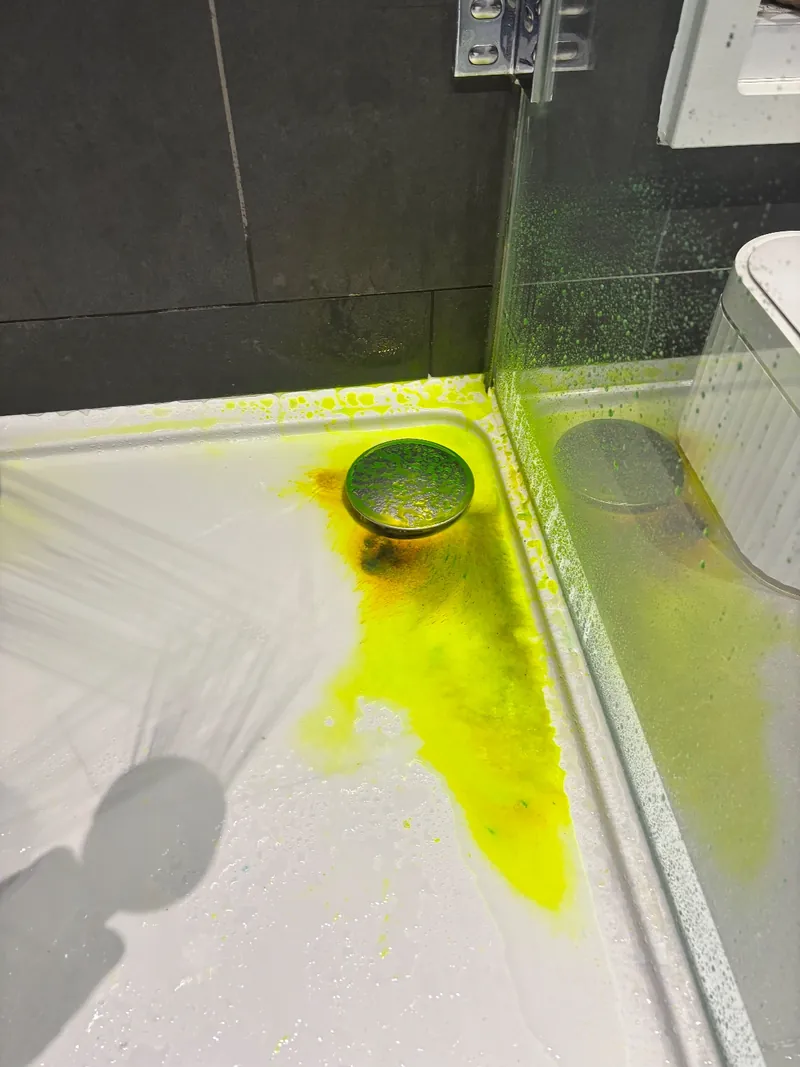
What a leaking shower waste looks like from the outside
The waste is the pipework that carries used water away from the shower tray: the outlet in the tray, a short run of pipe, the trap that holds a plug of water to keep drain smells out, and the pipe that carries on to the stack or the drain. It is not under pressure the way the supply pipes are. It only carries water when someone is showering. That is why the symptoms are so odd.
People notice a stain on the ceiling of the room below, but only after the shower has been used. They notice a damp patch on a bathroom wall that is dry for days and wet again in the evening. They notice a smell from under the bath panel. They notice that the meter is still, with every tap off, and wonder why a leak that costs them a ceiling does not show on it. The answer is that a leak in the waste does not run until water goes down it, so the meter has nothing to show.
That last point is useful. A pattern of water that appears only after a shower, and nothing when the shower is unused for a day, points us away from the supply pipes and towards the tray, the seal around it, the waste outlet or the trap. It is a hint, not a diagnosis. A failed seal around the tray edge can look identical from below, and so can a split in a shower hose or a cracked tile grout line. Part of the first hour is working out which one it is.
What you can check yourself before we arrive
You do not need tools for any of this, and none of it involves taking a panel off or a pipe apart.
- Do the meter check with every tap and appliance off. Our guide to the water meter leak test goes through it. A meter that does not move is consistent with a leak on the waste or a leak that only runs during use, though it does not prove it.
- Run the shower for a few minutes, then stop, and watch where the damp appears and how quickly. Water that shows within minutes suggests a path that is short and direct. Water that shows an hour later suggests it is travelling along a joist or soaking through a floor first.
- Look at the tray edge, the grout and the sealant lines for gaps. A visible gap lets spray reach the floor, which is a different cause from a waste leak and is covered in our page on rotten shower tray edge leaks.
- Fill the tray with a plug in, if it has one, then let it go. A leak that only appears while the tray drains points at the waste or the trap. A leak that shows with the tray full but not running suggests the outlet seal.
- Take dated photos of the stain or damp patch with a coin beside it for scale. Photos from a few days apart show whether it is growing.
Do not dry out or paint over the damp before we have seen it. The pattern of the stain is evidence. If water is coming through a ceiling quickly, stop using the shower and read what to do in the first hour of a leak in case the cause is on the supply side.
What the first hour is for
The first hour costs £100. On a suspected waste leak, the aim is to put the water somewhere specific instead of guessing. For most jobs of this kind, though it depends on access, the hour goes something like this.
- A short conversation about what you have seen, when, and what the shower and the room below are like.
- A meter and isolation check, so that a supply pipe leak is ruled in or out before anyone looks at the waste.
- A moisture and thermal imaging scan of the bathroom floor, the wall and the ceiling of the room below, to see where the water has spread.
- A controlled shower test: running the shower, then filling and releasing the tray, while someone watches the likely points. Where the stain shows only when water goes down, the waste is the suspect.
- A dye test where it helps, which colours the water so that its route can be seen. Our page on the shower tray dye test explains it.
- A camera inspection through a service hatch, a panel or the ceiling void below, where one exists, to look at the joint itself.
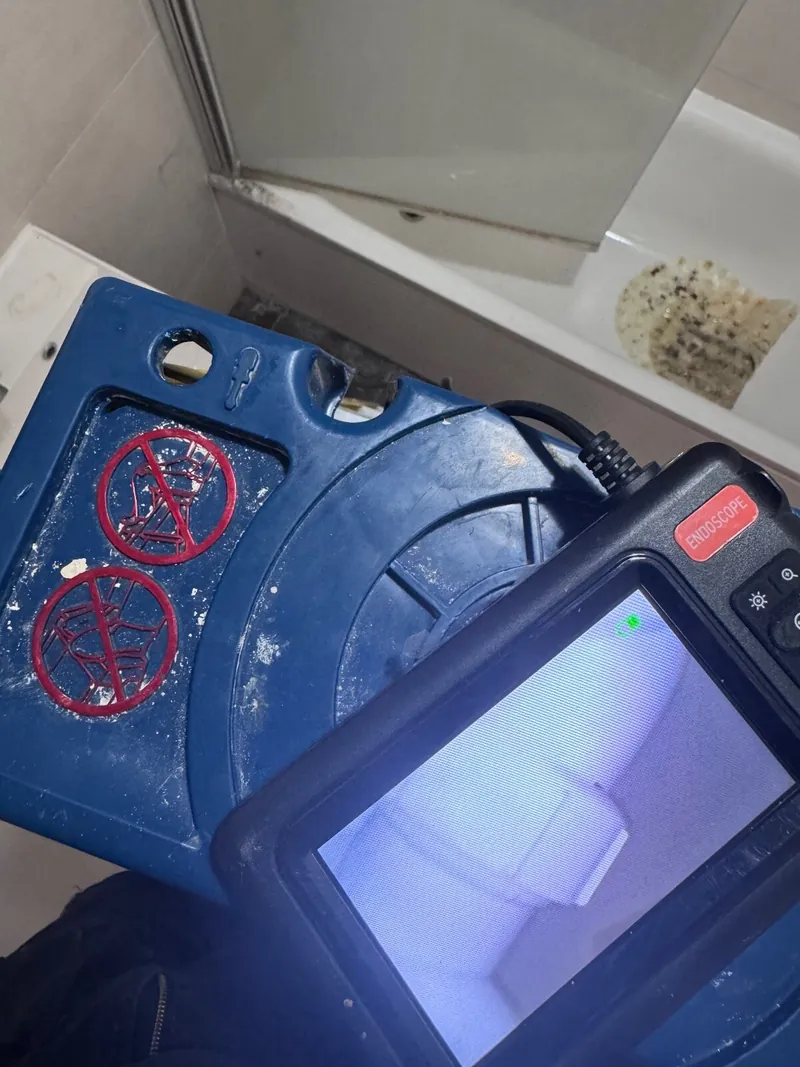
We try to use methods that do not need anything opened. Two methods that agree are a finding. One reading on its own is a lead, and we say which of the two you have. The rate includes tracer gas, acoustic detection, thermal imaging, an endoscopic camera inspection, a trace and access report for your insurer and a written quote for the remedial works, so there is no separate charge for the camera or the dye. Our overview of non-invasive leak detection describes each method and where it stops being useful.
If the hour ends with a leak found and accessible, you get a written quote for the repair before any work starts. As we are plumbers as well as leak specialists, we can usually carry out the repair afterwards if you approve the quote, though you are free to use someone else with the written finding.
What a waste leak usually turns out to be
In our experience, and this is a practitioner view rather than a statistic, shower waste leaks tend to come from a short list of places. The most common are the joint between the tray outlet and the waste pipe, the trap and its connections, and the push-fit or solvent joint where the waste meets the rest of the run. Less often the pipe itself is cracked, or the tray outlet seal has failed from the underside.
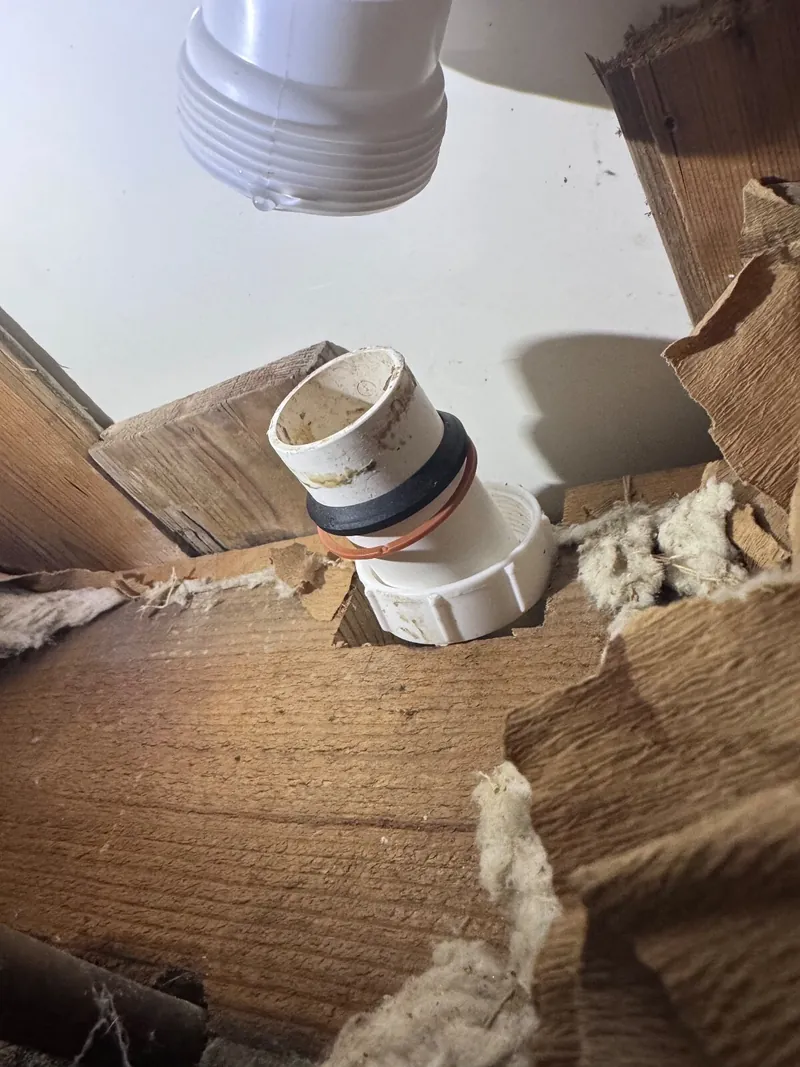
A push-fit waste joint relies on a rubber seal ring sitting properly in its socket. If the pipe was not pushed fully home, or a ring has slipped, the joint can weep only when a lot of water goes through it at once. That is one reason a leak shows when a shower runs for a while, not when a basin is emptied.
A trap is the other place we look first. It is a curved or bottle-shaped fitting under the tray that holds water to block smells, and it has two or more connections, each with its own seal. A trap can also be fitted with too little fall on the pipe after it, so water sits and pushes against a joint it was never meant to stress.
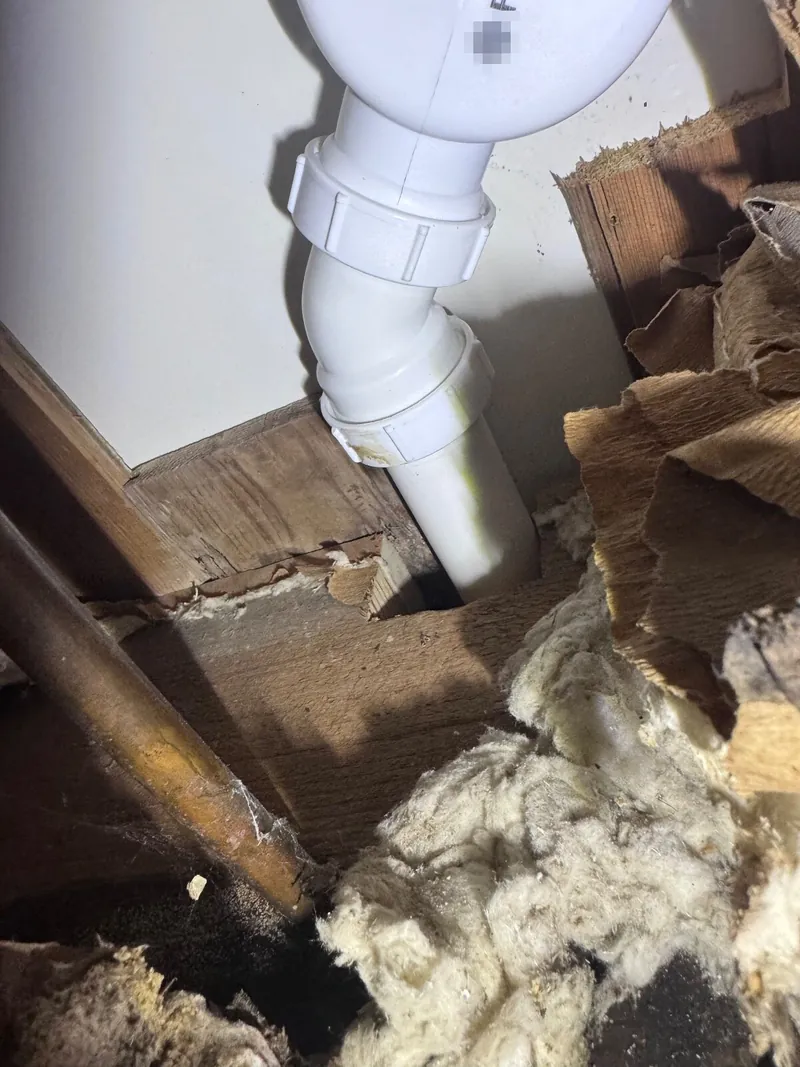
In both photos the fittings can only be seen because the floor has been opened. In many bathrooms the trap is behind a tiled panel or boxed in under a fixed tray with no access at all. That is the main reason a waste leak is quick on some jobs and slow on others. The finding takes the same method. Getting to the joint to repair it is where the time goes.
Where the leak is ongoing and has already soaked a floor or a ceiling, the damage is a separate matter from the pipe. Our case study of a shower waste leak through a flat ceiling shows how one job of this type was approached, and our guide to moisture mapping and damp diagnosis covers how we tell a plumbing leak from damp that has another cause.
What one hour can and cannot do
| Situation | Often a first hour can | Often needs longer or more access |
|---|---|---|
| Stain below, appears after showering | Show it is the waste or the tray and not the supply pipe | Confirm the exact joint if the trap is boxed in |
| Trap or joint reachable through a hatch | Find the weeping joint, quote the fix and sometimes re-seat it | Replace a cracked fitting that needs a part |
| Tray fixed down with no access panel | Narrow it to the tray, seal or waste with a dye test and a camera | Lift or remove the tray to reach the outlet |
| Waste runs through a floor or ceiling void | Trace the damp and mark the area to open | Open the floor or ceiling and repair the pipe |
| Ceiling already soaked below | Stop the cause and make a written record | Dry out and make good, which is separate work |
These are patterns, not a log of past jobs. We do not promise that a leak is found or fixed in an hour, and it would be wrong to. What we can say is that when the waste is reachable, the first hour is often enough to find it, write the quote and in some cases do a simple repair such as re-seating a joint with a new seal.
A job usually needs more than an hour when there is more than one source, when the waste is hidden under a fixed tray or a tiled floor, when the pipe has to be drained and dried before it can be sealed, or when the damage below needs to be recorded for an insurer. If you need that record, see leak detection report for an insurance claim.
What it would cost under the pricing
Standard leak detection is £100 for the first hour, then £150 an hour, billed in half hours after the first hour, and everything is included: tracer gas, acoustic detection, thermal imaging, an endoscopic camera inspection, a trace and access report for your insurer and a written quote for the remedial works. No VAT charged, and there is no parking charge. If the first hour answers the question, the survey part comes to £100.
| Time on site | Total |
|---|---|
| 1 hour | £100 |
| 2 hours | £250 |
| 3 hours | £400 |
A typical 2.5 to 3 hour survey is £325 to £400, and that is the realistic expectation when the waste is not easy to reach or the cause is not obvious. These figures are worked out from the rate, not taken from past jobs, and they are a guide, not a cap. We call you before the survey goes past 3 hours, so you decide whether to go on. A leak on the buried supply pipe is a different job at a fixed £450, however long the job takes.
The repair is not part of those prices. Once the leak is found, you receive a written quote for the work, and it is quoted separately. No find, no fee: if a leak is present and we do not find it, you pay nothing. The full rate card is on the pricing page.
When to call
- a ceiling or wall stain appears after the shower has been used and goes quiet when it has not
- there is a smell under the bath or tray that cleaning does not remove
- the shower drains slowly and the floor beside it is damp
- you need a written finding for a landlord, a managing agent or an insurer
- you are not sure whether the cause is the waste, the tray seal or the grout
Book through report a leak or call 020 3961 5444, and we confirm the rate and the time before anyone travels. The wider offer is leak detection for £100 for the first hour, the other jobs of this kind are on leak jobs that can be solved in one hour, and the guides cover the background.
