

What the meter chamber is, and whose it is
The meter chamber, often called a meter box, is the small covered pit in a drive, garden or footpath where the water meter sits. Thames Water says meters are most often outside under a small cover near the outside stop valve, though some are further away, in a shared pit, or indoors under the kitchen sink. Our guide on where is my water meter helps you find yours.
The outside stop tap and the meter are Thames Water's equipment, according to its own leakage code of practice. That means we do not operate or repair them. What we can do is listen at the cover, test the pipe on the house side, and tell you which side of the meter the water is likely coming from. Where the meter sits does not decide who owns the pipe, so the ownership question is a separate one. Read boundary box and stop tap: who owns it and who owns the water supply pipe.

Signs that point to the meter area
- The meter chamber is full of water, or fills again soon after it is emptied.
- The meter turns with every tap and appliance off and the inside stop valve closed.
- A wet or sunken patch of ground near the cover, or green and lush grass along a line.
- A hissing sound when you lift the cover or put your ear near the ground.
- A bill that has risen with no change in how the household uses water.
A chamber full of water does not always mean a leak on your pipe. Rain, a high water table or a leak on a neighbour's side can all fill it. That is a practitioner's point, not a rule, and the pit has to be looked at before it can be ruled in or out. See water meter box leaking or full of water and signs of a mains water leak.
If the meter moves with everything off, the safe test you can do first is the one Thames Water describes: switch off water-using appliances, close the inside stop valve, read the meter, wait 30 minutes and read again. If the reading has moved, Thames Water says the leak is between the meter and the inside stop valve. Our guide to how to do a water meter leak test goes through it. Do not lift a heavy cover on a road or footpath, and do not put your hand into the chamber.
What can happen in the first hour
The first hour costs £100. For a meter chamber it can go like this, though the steps vary with the layout.
- We take meter readings with appliances off and the inside stop valve closed, then open, to see on which side of the stop valve the water is moving.
- We look at the chamber from above and listen at the cover and along the pipe with acoustic equipment.
- Where it helps, we lower a sampling probe towards the meter and pipe joints and use a handheld detector, as in the photo below, to sniff for tracer gas that has been put on the house side of the pipe.
- We check the pipe route to see where it runs between the chamber and the building, and what lies above it.
- We tell you the likely position, or whether the meter area is clear and the search moves on.
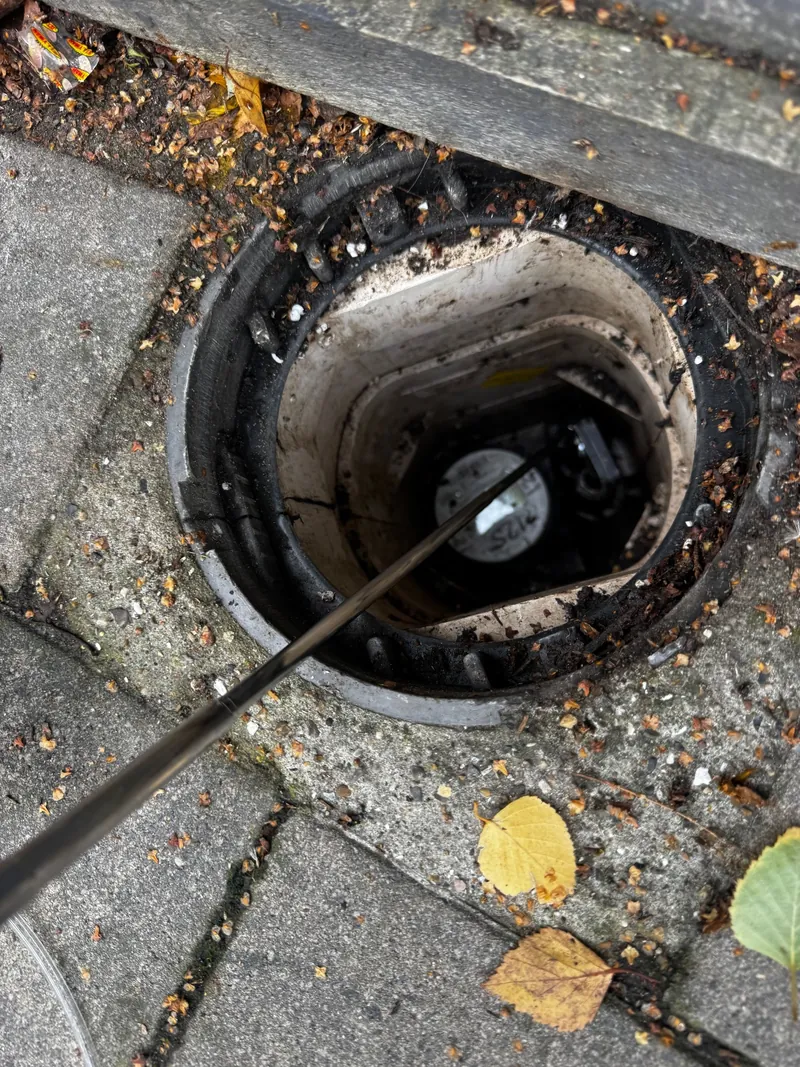
Tracer gas here means a harmless gas mixture that is put into the section of pipe being tested. If the pipe is leaking, the gas can rise to the surface, where the detector picks it up. The method is explained on tracer gas leak test in one hour. A reading at the chamber does not always mean the leak is in the chamber, because gas can travel along the pipe trench, and we confirm with a second method before saying so.

The standard rate includes tracer gas, acoustic detection, thermal imaging, an endoscopic camera inspection, a trace and access report for your insurer and a written quote for the remedial works. The report says what was tested, what was found and what was ruled out, and the written quote covers the next step. See what happens on the day.
What the first hour can tell you
| What we find | What it often means | Next step |
|---|---|---|
| Meter still, house side sound | No leak between the meter and the inside stop valve | Look at the water company side or at other causes, such as a reading question |
| Meter moving, house side shows gas readings at the chamber | A likely leak close to the chamber on the house side | Confirm with a second method and quote the access and repair |
| Meter moving, gas readings further along the route | A leak along the buried pipe, not at the chamber | Trace the pipe route; this usually takes longer than an hour |
| Chamber wet, house side sound | Water from rain, ground water or elsewhere | Check the chamber for signs the water is coming from the equipment side, and tell the water company |
If the water appears to be coming from the meter itself, the outside stop tap or the connection on the water company side, we say so and you report it to Thames Water. Its help pages describe how to report a leak. We do not promise that it will fix or pay for anything, so check its current pages. For the wider picture, see water meter leaking: who is responsible and water meter leak repair.
What usually needs more than an hour
- A buried leak along a long run from the chamber to the house, which needs route tracing and listening along the line.
- A shared pit or shared supply, where one pipe serves more than one home.
- A chamber that is full of water and has to be emptied or pumped before it can be checked.
- A cover that is stuck, heavy or in the road, where the right access has to be arranged first.
- More than one leak, so that finding the first one does not stop the meter.
Mains and supply pipe leak detection is a fixed £450, however long the job takes. It covers acoustic and ground-microphone detection, tracer gas, pipe route tracing, a trace and access report and a written quote for the remedial works. Excavation and the repair are quoted separately. Read leak between meter and house and supply pipe leak trace and repair. Where a survey is likely to run on, We call you before the survey goes past 3 hours.
What it would cost under the pricing
Standard leak detection is £100 for the first hour, then £150 an hour, billed in half hours after the first hour. Everything is included: tracer gas, acoustic detection, thermal imaging, an endoscopic camera inspection, a trace and access report for your insurer and a written quote for the remedial works. No VAT charged, and there is no parking charge. A typical 2.5 to 3 hour survey is £325 to £400.
| Where the leak turns out to be | Which price applies |
|---|---|
| A fitting or pipe inside the property | The standard rate: £100 for the first hour, then half hours at £75 |
| On the buried supply pipe | Mains and supply pipe leak detection: a fixed £450, however long the job takes |
| No leak present, or a reading question | We tell you what was ruled out, and the agreed survey time is charged |
| Time on site | Total |
|---|---|
| 1 hour | £100 |
| 2 hours | £250 |
| 3 hours | £400 |
These totals are worked out from the rate. They are not taken from past jobs. No find, no fee: if a leak is present and we do not find it, you pay nothing. Repairs are quoted separately in writing. The pricing page has the full rate card.
What to do now
- If water is flooding the property, close the inside stop valve. See how to turn off your mains water.
- Photograph the chamber and note the meter reading and the time.
- Do not dig, probe or force the cover.
- Tell the landlord or managing agent if you rent.
- Check Thames Water's current pages before relying on any bill allowance, since its help depends on circumstances.
Book through report a leak or call 020 3961 5444. See the wider offer on leak detection for £100 for the first hour, the other jobs on leak jobs that can be solved in one hour and the guides.
