
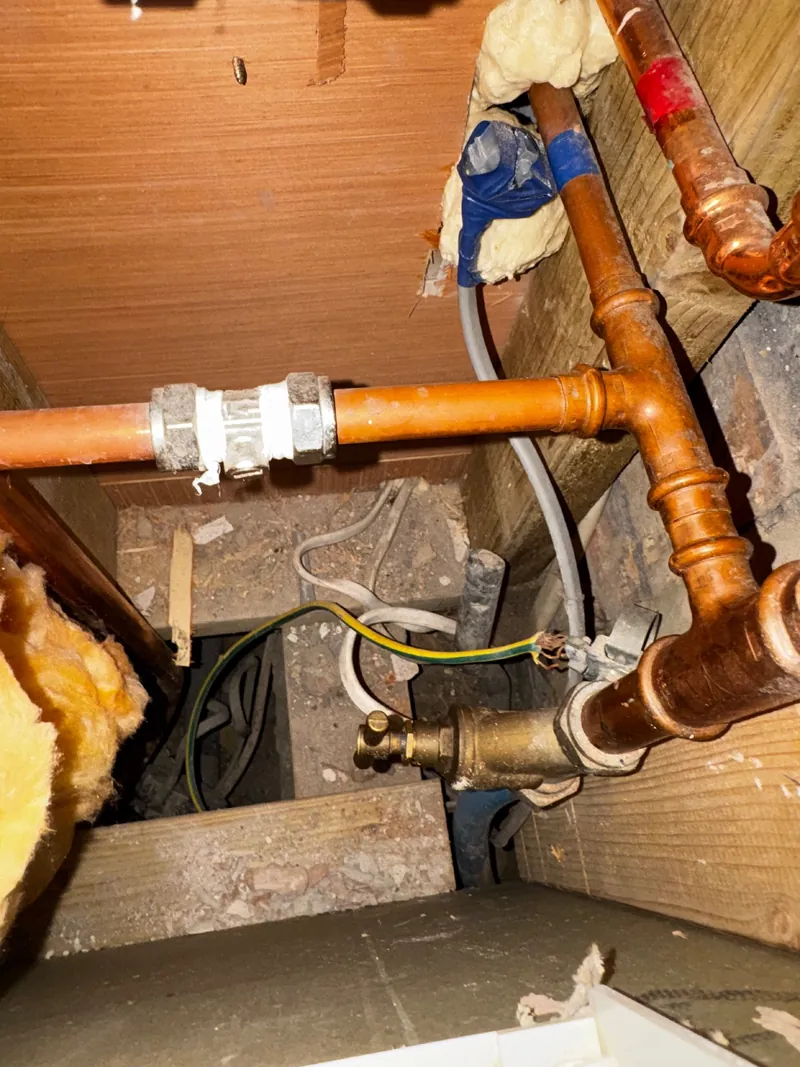
If water is leaking right now
You do not need to free the stopcock to stop a leak. You need to stop the water, and there are other ways. Work down this list and stop at the first one that works.
- If the leak is at one fitting, use its own isolation valve: the small valve under the tap, behind the washing machine, or on the pipe to a cistern. Stopcock and isolation valve maintenance shows where they are.
- If the water is coming from a heating or hot water fitting, leave the boiler and cylinder alone. Switch off only what you can reach safely, and call a qualified engineer.
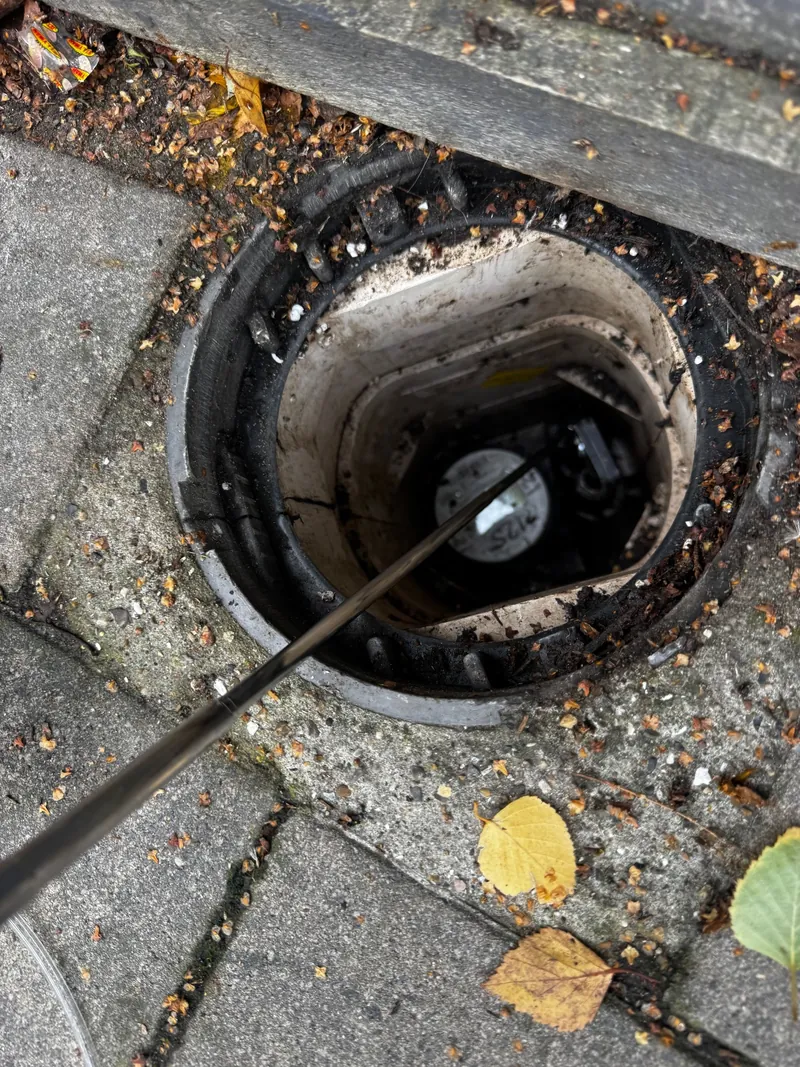
- If you cannot isolate the leak locally, use the outside stop valve, which Thames Water describes as the emergency back-up. It is usually under a cover on the path or the road and may need a stopcock key. Turn it clockwise, do not force it, and if you share a supply, tell the neighbours first. The stop tap in the street: who can turn it off and boundary box and stop tap: who owns it explain the position.
- Ring the water company if the outside valve is missing, buried or stuck, using the contact details on its own pages. We do not print its numbers because they vary between its pages.
- Ring a plumber. Emergency water leak repair explains how we work out of hours.
We are an independent leak detection and plumbing company, not Thames Water or any water supplier. Where this page paraphrases Thames Water or Which?, it is from their own pages, read on 25 November 2026. Where a statement is our own practitioner judgement and not a published source, it says so.
First, are you turning the right valve the right way?

Many valves that “won’t turn” are the wrong valve, or the right one turned the wrong way. Thames Water’s page on the inside stop valve says to turn the valve clockwise to turn the water off, that it may take several turns, and that you will usually reach a point where it stops turning. Anticlockwise opens it. It also says you should not need excessive force to turn it further.
- Check that it is on the pipe that brings the water in. Open the kitchen cold tap and see that the valve you have found is on the pipe feeding it. Where is my stopcock in a house and what does a stopcock look like help.
- Look at the handle. A wheel head takes several turns. A lever turns a quarter turn, and a lever that is already lying along the pipe may be open, or closed, depending on the valve. Check by opening a tap, not by guessing.
- Clear the space. A valve behind boxes, a boiler cover or a kitchen plinth is hard to turn and easy to strain. Move things out of the way first.
- Look for paint, tape, or limescale crust over the spindle. If paint has run over the join between the handle and the body, it may be glued in place.
- Wear a glove or hold a dry cloth around the handle for grip. Use the flat of your hand.
Give the valve one steady try. A firm, even pressure that you could apply with one hand, held for a few seconds, will move a valve that is merely stiff. If nothing moves, that is the answer: it has seized, or it is stuck for another reason. Do not try again with more effort. Damage usually comes from the later attempts, not the first one.
What “won’t turn” can mean
The symptom tells you what has failed. The causes below are our practitioner judgement from common faults, not a diagnosis of your valve.
| What happens | Likely cause (our judgement) | What to do |
|---|---|---|
| The handle will not move at all | Seized: scale and debris around the spindle. Which? says the cause is usually scale and debris and not rust, because plumbing parts are non-ferrous | Stop. Isolate another way and book a plumber to fit a new valve |
| Stiff at first, then it moves | Scale that has broken free, or a gland nut that is tight | Close and open it once only, fully, then log it and retest in a week. If it stiffens again, replace it |
| The handle spins freely and nothing moves | A stripped or snapped spindle, or a loose head | Treat it as failed. Do not try to grip the spindle. Replace the valve |
| It turns, but water still flows at the tap | A worn washer or seat that does not seal, or you have found a different valve | Do not rely on it. Replace it, or confirm which valve it is |
| Water weeps from the spindle when you turn it | A worn gland or packing | A plumber may re-pack it. Often replacement is neater. Do not tighten the nut hard |
| It will turn only part of the way, then locks | A spindle or washer that has jammed on scale part-way | Leave it where it is, partly open or closed, and book a plumber |
| It turns, but there is a bang or knock when you close it | Water hammer, which is a pressure shock in the pipes, and not a seizing fault | Close it more slowly. If it persists, ask a plumber about the pipework |
| You cannot reach it or see it | Boxed in, buried in a cupboard, or never fitted | See the section on replacement and extra valves below |
Which? adds that a stopcock that is tested once a year is much less likely to seize. If this is the first time anyone has touched it in a decade, seizing is no surprise. It is not a sign that anyone did anything wrong.
What not to force, and why
A stopcock is a small brass valve joined to a pipe, often a thin copper or plastic pipe, and on the other side is the supply pipe under your floor or garden. Everything you do to the valve is passed on to the joints either side of it. Which? says that too much torque on a stop tap can twist or snap the spindle, and that this usually means replacing the whole stop tap.
| Mistake | Why it goes wrong | Do this instead |
|---|---|---|
| A wrench, mole grips or a pipe as a lever on the handle | Snaps the spindle or the handle, or twists the pipe behind it. A joint can start to leak under the floor | Hand pressure only |
| Gripping the spindle with pliers | Rounds it off and removes the grip you may need later | Leave the spindle alone |
| Hammering the body or the pipe | Cracks a brass body or loosens a joint | Do not hit pipework |
| Penetrating oil or WD-40 | Which? says these are for rust, and not for the brass or copper used in plumbing, and that they can make a stop tap slippery to work. Views in the trade differ, so ask a plumber first | Leave a seized valve to a plumber |
| Heat from a blowtorch or a heat gun | Our judgement: it can soften soldered joints, damage plastic pipe and start a fire in a cupboard or behind a wall. Do not use it | No heat |
| Turning back and forth hard to “work it loose” | Wears the washer and the seat, and can drop scale into the seal | One gentle try, then stop |
| Using the outside stop valve as a routine fix | It is the water company’s apparatus, and on a shared supply it affects the neighbours | Use it only in a real emergency, and tell them |
If the valve gives a little and then stops dead, leave it where it is. A valve that is half open is a valve that is still giving you water. A valve forced shut that then will not reopen is worse, because now you have no water and no way to restore it.
Stopping the water when the stopcock will not
There are several ways to stop the water, and they differ in how much they cover and how safe they are for you to do yourself. Thames Water’s page on the inside stop valve points out that your property probably has several valves, so you may be able to turn off the water for the affected room only. It also lists three things a plumber can use when the usual valve is not working.
| Method | Who does it | What it covers | Notes |
|---|---|---|---|
| Local isolation valve under a tap, behind an appliance or at a cistern | You | One fitting | The best first move. If there is none, ask for them to be fitted |
| The outside stop valve | You, in an emergency | Your supply, and neighbours on a shared one | Thames Water calls it the emergency back-up. Clockwise to close, never force it, tell neighbours first. Which? says an old street stop tap that has not been turned for a long time is a matter for the water company |
| A permanent isolation valve fitted without turning off the water | A plumber | The pipe it is fitted on | Thames Water’s page mentions one such valve that can be fitted in around five minutes without shutting the supply. Ask whether the method suits your pipe |
| A device that shuts the supply by a switch | A plumber | Your supply | Thames Water says it must be fitted alongside a working inside stop valve, so it does not help with a seized one |
| Freezing and clamping the pipe | A plumber | A short length of pipe, for a short time | Thames Water says it makes an ice plug that lasts around 30 minutes. It is a short-term way to do a job, not a permanent fix |
| Isolating at the street or at the main | The water company | The street or the supply | Ask the water company. Which? says the company is responsible for an old-style street stop tap |
The first two you can do yourself. The others depend on the plumber and the pipe. We do not give a price for any of them here. Ask for the method and the price in the quote, and ask why that method suits your pipe.
When a seized stopcock should be replaced
A valve that will not move, spins freely, weeps or does not close fully has failed. It may not have leaked yet, but it will not do its one job when you need it. Which? suggests having a plumber fit a new stop tap ahead of a stuck one before an emergency, and says doing so avoids the cost and delay of draining the system when something goes wrong. The question is only when.
| Situation | Our view | Why |
|---|---|---|
| Seized, dry, and no leak anywhere | Replace at a time that suits you, before winter | The valve is not leaking but it is useless in a burst |
| Seized and weeping at the spindle | Replace soon | A weep can run for months in a cupboard and add to a bill |
| Spindle snapped or head spinning | Replace | There is nothing left to grip |
| Stiff but it closes fully and stops the water | Log it, retest, and plan replacement if it stiffens | Stiff is a warning, not a failure |
| Closes, but water keeps running at the tap | Replace | It does not seal |
| A leak is active and the valve will not close | Isolate another way first, then replace | You cannot fix a leak with a seized valve in the way |
The work is covered in stopcock replacement in London, including what is involved. Briefly, the supply has to be stopped upstream while the new valve is fitted, by one of the methods above. Ask for the new valve to be placed where you can reach it, with a clear space round the handle, and ask whether the plumber will test it in front of you before they leave. The water regulations expect workmanlike work to a recognised standard, and it is reasonable to ask for a written record of what was fitted.
Isolation valve options when you replace
A seized stopcock is the moment to fix the larger problem, which is having only one valve between you and the street. The Water Supply (Water Fittings) Regulations 1999, as we read schedule 2 as made, expect a stopvalve on the supply to separate premises, conveniently placed, and enough servicing valves and stopvalves that a system can be isolated in sections. Read the current text before you rely on our summary.
| Option | What it gives you | Think about |
|---|---|---|
| A new inside stop valve in the same place | A working main valve where you expect it | It fixes today’s problem but leaves a single point of failure |
| A lever (quarter turn) valve in place of a wheel head | A valve that is easier to turn in a hurry and easier to see whether it is open | Ask about a full-bore valve, which in our experience restricts the flow less. Check what suits your pipe |
| A second valve in a more reachable place | Another way to close the main supply, such as at the front of a cellar or in a cupboard you can open | A better position may need pipework to be altered |
| An isolation valve at each tap, appliance and cistern | Isolating one fitting without closing the whole house | Slotted or lever valves you can work without tools |
| A drain-off point next to the valve | Letting you empty the pipework after closing it | A plumber can add one. See how to drain down your water system |
Flats, rented homes and shared supplies
In many London flats the stopcock does not isolate only your home, or does not exist, and the main valve is communal. Do not close a communal valve without asking the managing agent, because it can cut the water to other flats. If your own valve is seized, tell the agent in writing with a photograph, and ask who is responsible for it under your lease. Leak prevention for flats and managing agents covers the building side.
If you rent, a seized stopcock is a repair you report, not one you fix. In tenancies covered by section 11 of the Landlord and Tenant Act 1985, the landlord has to keep installations for the supply of water in repair and working order, and the statute’s own wording is worth checking against your tenancy. Tell the landlord in writing, and do not hire someone to replace it without agreeing it first. If the water is already escaping, isolate it, tell the landlord, and keep the photographs.
If the valve closes but the meter still moves
Sometimes the valve is the lucky find in a bigger problem. If the stopcock moves and closes, but the water meter still turns with every tap and appliance off, the water is leaving before the valve, on the supply pipe, and a new stopcock will not fix it. How to do a water meter leak test gives Thames Water’s 30 minute method, and signs of a mains water leak lists the other signs.
A seized valve and a leak can arrive together, because both come from old pipework. If you cannot find where the loss is, we trace it without digging up more than we need to. A mains and supply pipe trace is a fixed £450, however long the job takes. No VAT charged. See pricing and how we price. The repair is quoted in writing once the leak is found, and we can carry it out ourselves. If low pressure is the symptom, see low water pressure causes and checks.
To arrange a visit, report a leak or ring 020 3961 5444. The rest of the series is in the guides hub.
