Why underground leaks are easy to miss
A leak on a buried pipe has nowhere obvious to go. Water soaks into the soil, runs along the sand around the pipe, or drains away into the ground, so for weeks there may be nothing to see. When it does show, it often shows in the wrong place, because the water travels along the pipe trench or a drain run before it surfaces. The wet patch on the lawn can be several metres from the break.
That is why the signs below are best read together. One of them on its own is a reason to look more closely. Two or three, especially with a moving meter, is a reason to book a survey. Everything on this page is about the pipe between the street and your house, which is normally the owner’s supply pipe; leaks inside the house have their own symptoms and are covered elsewhere, for example in signs of a mains water leak.
Sign 1: the meter keeps moving
If you are metered, this is the cleanest evidence you can get without any equipment. Thames Water’s identifying-leaks page, read on 24 November 2026, gives this routine: switch off all appliances, close the inside stop valve (usually under the kitchen sink), take a reading, wait 30 minutes, take another. If the readings differ, it says there is a leak somewhere between the meter and the inside stop valve.
Why that points underground: with the inside valve shut, the house plumbing is cut off from the supply. Any water the meter still counts is leaving the supply pipe before it gets to the stop valve, and for most houses that stretch is buried. The exception is a meter fitted inside the house. In that case the leaking section can be a short run of pipe in the hallway or kitchen floor, so it is worth looking before you assume it is in the ground.
- Many meters have a leak indicator, often a small star, triangle or dial, that turns when any water passes. If it turns with the house shut off, water is moving.
- Take a reading before bed and another in the morning without using water in between. A single digit of movement overnight on a quiet household is worth a second look.
- Smart meters report hourly readings. Thames Water says customers with an online account can track use. A steady overnight baseline that never drops to zero is the pattern of a leak, but the page does not say that alerts are sent automatically, so do not expect one.
Full steps, with a worked example, are in how to do a water meter leak test. If you do not know where the meter is, start with where is my water meter.
Sign 2: what the ground and the surface tell you
Thames Water lists several outdoor signs on its leak page: damp patches in the garden during dry weather, cracks in paving, potholes or sinkholes appearing, and dirt or air in the water. From the jobs we attend, these are the variants that come up most:
- A patch of lawn that stays green and lush while the rest of the grass browns in a dry spell.
- A permanently soft or boggy spot with no tap, downpipe or gully nearby.
- Block paving that has dipped, or slabs that rock when you step on them. Water washes the bedding sand away from underneath.
- Moss, algae or a dark stain that keeps coming back at one point on a path, drive or patio.
- A thin line of cracking in tarmac or concrete, running in the same direction as the pipe’s likely route.
- Water standing at a low point in dry weather, or a trickle running down the kerb from your property.
- Bubbling or a small spring of water at a manhole or gully that is clean and clear rather than foul.
Each has an innocent explanation. Lush grass can be a leaking drain, a gutter overflow or simply a damp corner. Dipped paving can be a poorly compacted base. A trickle in the kerb can be a neighbour washing a car. The reason to look for a pattern is to avoid either dismissing a real leak or digging up a perfectly good path.
Sign 3: what happens inside the house
A leak under the garden or floor can show up indoors without any pipe being visible. The signs are more subtle than a burst pipe:
- Lower water pressure, or taps that run weakly at certain times of day. Thames Water lists noticeably lower pressure among its common leak signs.
- A whooshing, hissing or trickling sound near the stop valve or where the supply pipe enters the house, audible when everything is quiet at night.
- A cold, damp patch on a solid floor over the route of the pipe, or a floor covering that has started to lift or smell musty.
- Damp at the base of an external wall, particularly the one closest to the street or the meter.
- The inside stop valve feels warm or sweats, or the pipe sweats, in a way it did not before. (A sweating cold pipe in a warm room is common too, so do not read this on its own.)
- Air, sputtering or discoloured water after the supply has been off. Thames Water lists dirt or air in the water as a sign.
Pressure falls that affect the whole street, or happen at a particular time, are more likely a network issue than your pipe. Ask neighbours. Thames Water has a “no water or low pressure” page and a report-a-problem page; see their report page.
Sign 4: the bill and the usage pattern
A bill that jumps for no obvious reason is often the first thing people notice. Thames Water lists extra occupants, weather, renovations and leaks as reasons for a higher bill, and says estimated bills are adjusted when a real reading arrives. So check the basics first: is the bill based on an actual reading, has anyone moved in, have you filled a pool or watered more?
If none of that fits, compare usage per day against previous periods. A leak adds a flat, constant amount to every day, including days when no one is home. A household that is away for a week and still shows steady use has a very strong signal. If you are unmetered, there is no usage figure to compare, so the ground and house signs matter more. See why is my water meter reading so high and estimated water bill: what to do.
Note that Thames Water says it takes its own meter readings at least every two years, partly to check for leaks and overcharging. That is a backstop, not an early warning, so do not wait for it.
Symptom to likely cause, at a glance
| What you see | Most likely | Next step |
|---|---|---|
| Meter moves with every tap off and the inside stop valve shut | Leak on the supply pipe, or a leaking fitting at or just after the meter | Repeat the test once; if it still moves, book a trace |
| Wet ground in dry weather, meter still | Drain, gutter, soakaway or a pipe that is leaking only under pressure from a tap in use | Check gutters and drains; run the meter test with a tap open outside |
| Wet ground, meter moving | Supply pipe leak, wet area close to the break or along its trench | Do not dig; arrange tracing |
| Low pressure, whole street affected | Network issue on the main | Ask neighbours, report to Thames Water |
| Low pressure, only your house | Supply pipe leak, a partly closed stop valve, a blocked filter or an old narrow pipe | Check the stop valve is fully open; run the meter test |
| Sunken paving or a dip over the pipe route | Washed-out bedding from a long-running leak, or a poor base | Meter test and a survey; do not lift paving first |
| Hissing at the stop valve in a silent house | Leaking supply pipe or a faulty fitting | Meter test; call for a plumber or a trace |
| Bill up, no meter movement now | Past leak, estimated bill or change in use | Compare readings; ask your supplier for a review |
Treat the table as a guide to the order of checks, not a diagnosis. If you need one, a survey gives you the position of the leak and a written report. If you are in a flat or a shared house, see also leak between meter and house.
What to do now
- Run the meter test once. Write down the readings and the time.
- Look for the patterns in the lists above and photograph what you find with the date.
- Check gutters, gullies, outside taps and hoses so you rule out the cheap explanations.
- If the meter moves, close the inside stop valve whenever the house is empty or overnight until the fault is dealt with. How to turn off your mains water explains how, safely.
- Tell your insurer if there is any damage. Thames Water advises checking home emergency or buildings insurance before arranging repair, because some policies cover supply pipe leaks. Cover varies, so check your policy.
- Have the leak traced before anyone digs. Water leak under a driveway covers the same route when the pipe runs under a drive.
Thames Water’s page on arranging a repair says a confirmed leak on your property should be repaired within four weeks of you finding it or being told, so the timer effectively starts when you confirm it. Keep your meter readings and photos; they are also the evidence you will need if you later ask for a leak allowance. Our leak allowance evidence checklist lists what to keep.
What not to do
- Do not dig up a lawn, path or drive to look for the pipe. Gas, electric and telecom cables can run in the same ground, and the leak is rarely under the wet patch.
- Do not pour acid, descaler or drain chemicals into the ground or the stop tap, and do not use leak sealants on a buried supply pipe.
- Do not cut into or clamp a pipe you cannot positively identify.
- Do not force a stop valve that will not turn. A seized stop valve that snaps leaves you with no way to isolate the house. Call a plumber.
- Do not ignore wet floors or damp walls that sit near a socket or fuse board. Switch off the affected circuit at the consumer unit first.
- Do not assume it is the water company’s. Thames Water says the supply pipe from your boundary into the home is the owner’s responsibility, while it looks after the mains and the communication pipe. See who owns the water supply pipe.
How an underground leak is confirmed and located
Confirmation and location are two different jobs. The meter test confirms that water is leaving the supply pipe. A survey tells you where. We usually start with the pipe’s route, because a search along a line is cheaper than a search across a whole garden.
- Pipe tracing finds the route by electronic locator or probe. It struggles on plastic pipe without a tracer wire.
- Acoustic listening picks up the sound of water escaping, compared between two points. Plastic pipes and quiet, small leaks give weaker signals, and traffic or machinery can drown the sound out.
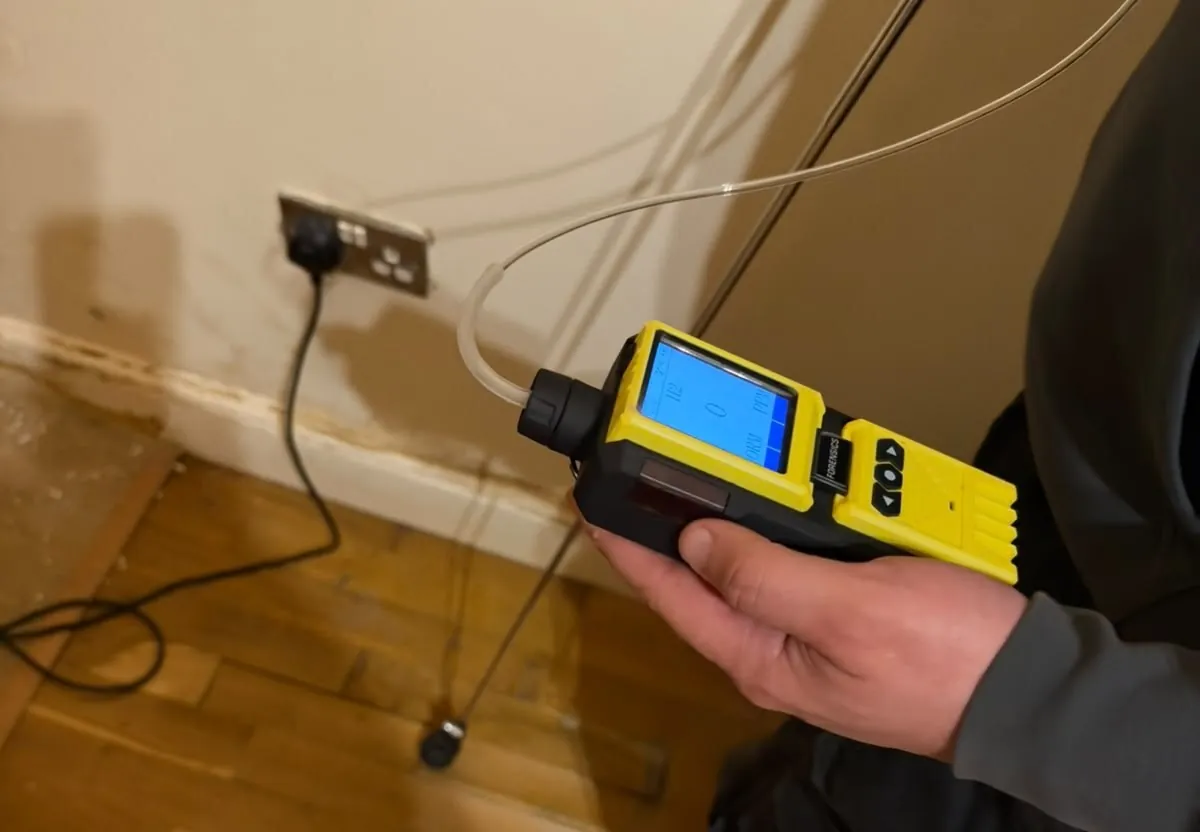
- Tracer gas is a hydrogen and nitrogen mix put into the isolated pipe and detected as it reaches the surface. Dense surfaces slow it, so small access holes can be needed.
- Thermal imaging helps mostly with hot or heating pipes, and gives limited contrast on cold mains water.
None of these guarantees a point on every job, and we say so in the report. Costs are on the pricing page: mains and supply pipe tracing is £180/hr, a typical visit is £360 to £540, and tracer gas adds a one-off bottle charge of £80 when it is used. No VAT charged. Repairs are quoted separately once the leak is located.
To start, report a leak or ring 020 3961 5444. For the service itself, see underground supply pipe leak: trace and repair.