
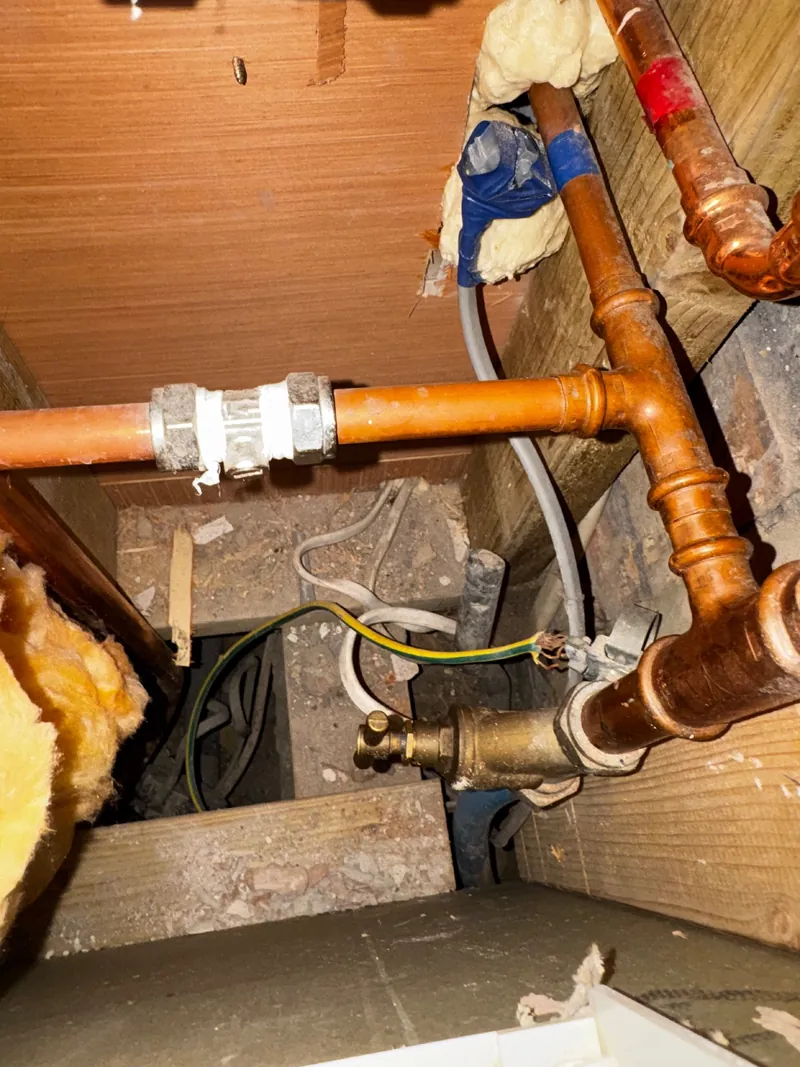
What is usually wrong with a dripping tap
A tap that drips with the handle shut is letting water past the part that is meant to seal it. On a traditional tap with a separate hot and cold handle, that part is usually a rubber washer pressed on to a seat inside the body. On a mixer or a lever tap, it is usually a cartridge. The seal wears, the seat gets rough, or limescale builds up, and a slow drip starts.
That is the common story, and it is a practitioner view rather than a rule. A drip can also come from the spout, from around the base of the tap, from the handle, or from the pipework under the sink. Each of those has a different fix, so the first job is to see which one it is.
Because a drip is quiet and steady, people live with it for months. It is worth fixing, though. If your home is on a meter, the water is paid for, and on any bill it is a small leak that wears at the fitting. Our page on the yearly cost of a dripping tap and a running toilet puts figures on it.
Safe checks you can do first
These take a few minutes, need no tools and do not open any pipe.
- Watch where the water appears. Does it fall from the end of the spout, run down the outside of the tap, or collect at the base or in the cupboard below?
- Dry the tap and the area around it, then check again after ten minutes. A fresh, repeated drop tells you more than a damp patch.
- Look under the sink at the two small pipes feeding the tap. If there is a wet patch there, the leak may be in the supply side, not the tap itself. That points to a different job.
- Check whether it drips from hot, cold or both. A tap that only drips when the hot is on often points to the hot side of the fitting.
- Find the small isolation valve on the pipe feeding the tap, if there is one, and check that you know where it is. A slot-headed valve turns a quarter turn with a screwdriver. Do not force it if it is stiff.
If the water is coming from under the sink and not from the spout, or the cupboard is damp and swollen, treat it as a leak on the pipework rather than a dripping tap. Turn the water off at the inside stop valve, which Thames Water says is usually under the kitchen sink, and read how to turn off your mains water.
You do not need to take the tap apart to book us. If you are comfortable changing a washer or a cartridge yourself, leaking tap repair and replacement goes through the options.
What we do in the first hour
The first hour is £100. For a dripping tap, it usually runs like this.
- We ask when it started, whether it drips hot, cold or both, and whether anyone has worked on the tap before.
- We watch the drip and confirm the source. We look for water at the spout, the handle, the base and the connections beneath.
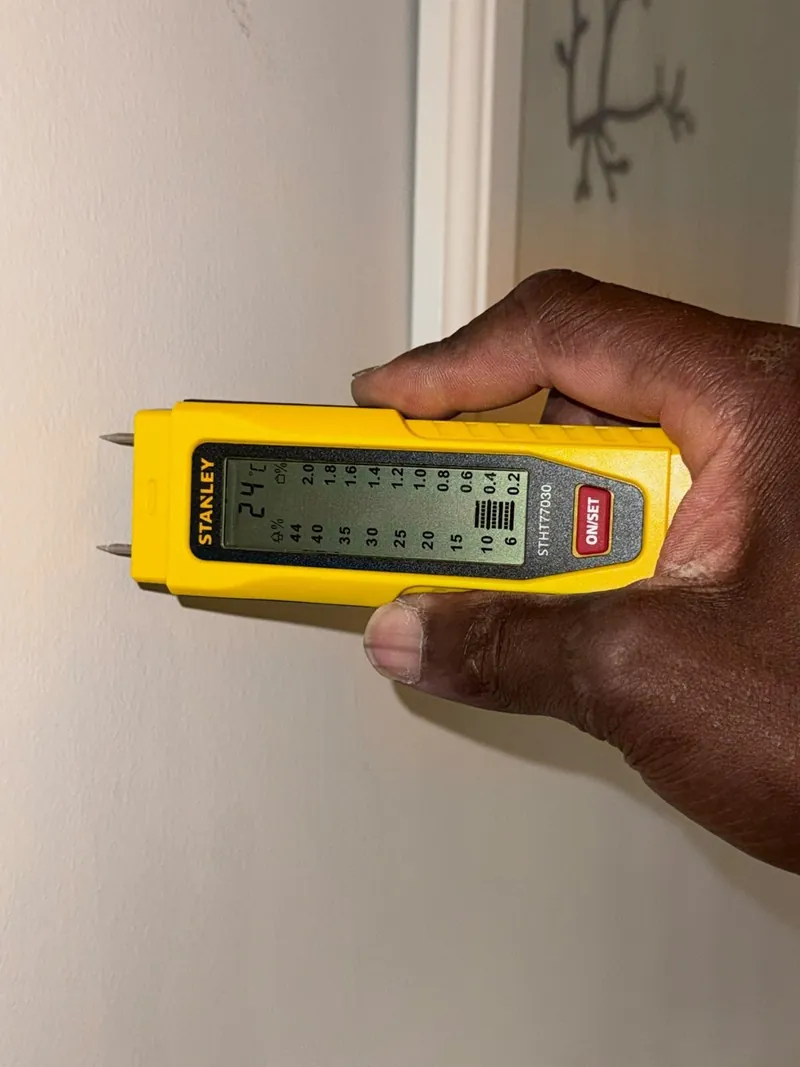
- We check the nearby area with a moisture meter, so any damp in the worktop, cupboard or wall is on record before anything is changed.
- We isolate the supply to the tap, where the valve works, and identify the type of tap and what part has failed.
- We tell you the repair in plain words and give you a written quote.
Often that is all it takes to turn an annoying drip into a clear job: this washer, this cartridge, or this tap needs replacing. Leak detection is the part we are built for, so where the tap is clearly the source, the first hour is mostly confirmation. Where it is not, the same hour is what stops you replacing a tap that was never the problem.
The standard rate includes tracer gas, acoustic detection, thermal imaging, an endoscopic camera inspection, a trace and access report for your insurer and a written quote for the remedial works. A dripping tap rarely needs tracer gas or acoustic equipment. Thermal imaging and moisture readings are more likely to be useful, and only if there is damp nearby.
What usually needs more than an hour
We would rather say this plainly. A dripping tap can run past the first hour when:
- The isolation valve under the sink is seized or missing, so the tap cannot be isolated on its own and the whole supply has to be shut off.
- The tap is old, and replacement parts are hard to match or the body is corroded.
- The drip is only part of the story, and the damp under the sink shows a second leak on the pipework or waste.
- The tap is in a tiled, boxed-in or hard-to-reach position, such as a freestanding bath tap or a wall-mounted fitting where the pipes are behind the finish.
- There is damp or staining that suggests the water has been escaping for some time and has travelled.
If the isolation valve is the problem, see stopcock and isolation valve maintenance and stopcock won't turn or is seized. A valve that will not close is worth knowing about before an emergency, and it can add to the visit.
If the damp under the sink turns out to be a hidden leak, the job becomes a detection survey. The page on finding a hidden leak in one hour explains what that first hour does.
What it would cost under the pricing
Standard leak detection is £100 for the first hour, then £150 an hour, billed in half hours after the first hour. No VAT charged, and there is no parking charge. If the tap is clearly the source and the visit stays inside the first hour, the survey part is £100.
| Time on site | Total |
|---|---|
| 1 hour | £100 |
| 1.5 hours | 175 pounds |
| 2 hours | £250 |
| 3 hours | £400 |
These are totals worked out from the rate. They are not the price of any past job. The repair is not in them: a new washer, cartridge or tap is quoted separately in writing, with the parts and the work set out, so you can accept it or take it elsewhere. Repairs are never priced on this site, because the fix depends on the tap.
We call you before the survey goes past 3 hours. The full rate card is on the pricing page.
When to call
A slow drip is not an emergency, but it is not a reason to wait for a year either. Call when:
- the tap has dripped for more than a few days and a washer change has not stopped it
- there is water under the sink or in the cupboard, not just at the spout
- you cannot isolate the tap, or the isolation valve will not close
- the drip comes with a stain on a ceiling below, which suggests the water has been moving
- you rent, and the landlord or agent needs a written finding, see who is responsible for a water leak
To book, use report a leak or call 020 3961 5444. We confirm the rate and the time before anyone travels. For other jobs that fit a first hour, see leak jobs that can be solved in one hour, and for the offer itself, leak detection for £100 for the first hour. The guides cover the surrounding questions.
Repair or replace the tap
Once we know what has failed, the choice is usually between a new part and a new tap. As a rule of thumb, a worn washer or cartridge is a small repair on a tap that is otherwise in good order. A corroded body, a tap that has been repaired several times, or parts that are no longer made points towards replacement.
We quote both when both make sense, so you can compare the price of the repair with the price of a new fitting. Neither is included in the survey rate. If you plan to replace the tap anyway, it is worth fitting new isolation valves while the supply is off, and we will say if yours need it.
Fittings must not waste water. The Water Supply (Water Fittings) Regulations 1999 bar installing or using fittings in a way that wastes or misuses water, and say repairs should be workmanlike. We mention it as background, not as a threat: a dripping tap is the sort of thing the rule is about. Check the current text on legislation.gov.uk if you need it for a tenancy or a sale.
