

A damp wall is not always a leaking pipe
People often ring about a damp wall expecting a hidden pipe leak. Sometimes that is right. Often it is not. A wall can be damp because of a plumbing leak, but also because of a failed seal around a shower or bath, condensation on a cold surface, rain getting in through a roof, gutter or window, a defect in a neighbouring flat, or moisture rising from the ground in an older building.
The difference matters because the fixes are unrelated. Replacing a pipe will not cure condensation. Treating a wall for damp will not stop a pipe from leaking. The first step is to find out whether water is involved at all, and if so which kind of water.
That is what a moisture check is for. It does not diagnose everything. It narrows the options so the next step is the right one.
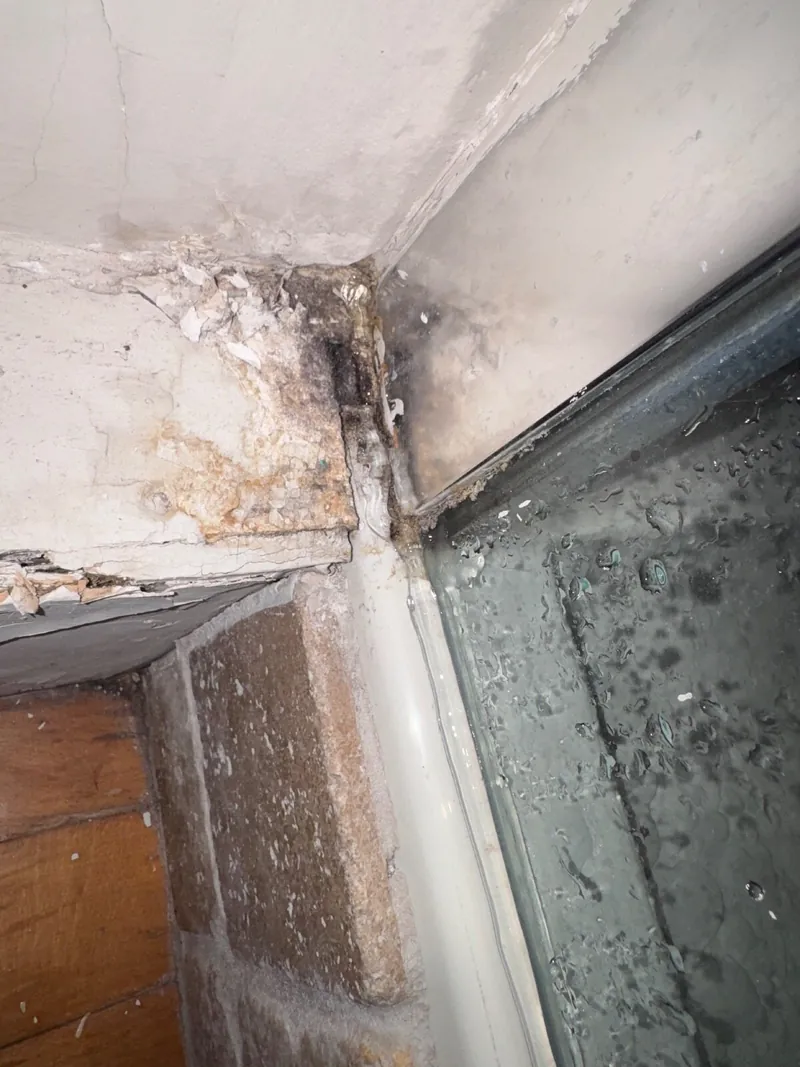
A corner like the one above, beside a shower screen, is a typical place for staining. It could come from the shower seal, from condensation or from a pipe in the wall. The picture shows the damage, not the cause.
What the tools tell us and what they do not
Two instruments do most of the work on a damp wall check. Each has limits.
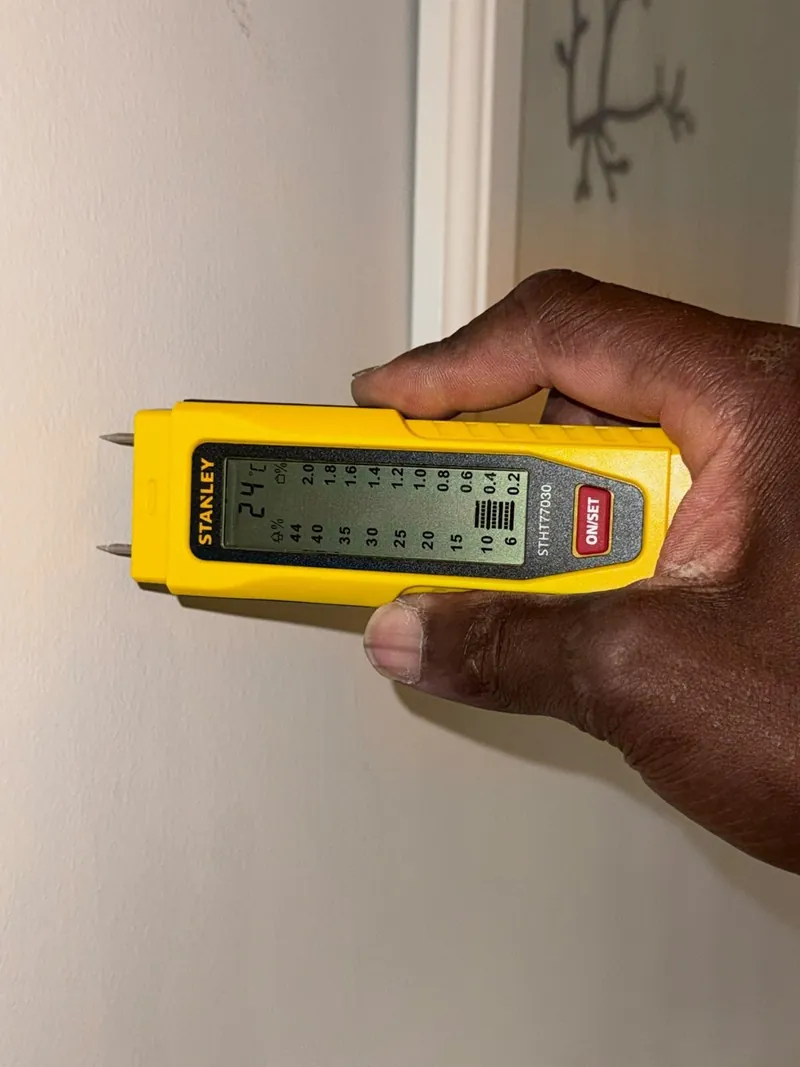
A moisture meter measures the amount of moisture near the surface of a material. A pin-type meter, like the one above, has two small probes that press into the surface and read the electrical resistance between them. A higher reading usually means a wetter material. The numbers are relative, so we compare a suspect area with a dry area of the same wall and the same finish, not with a figure on a chart. The meter is a practical guide, not a laboratory measurement, and it can be affected by salts, paint, foil-backed plasterboard and some building materials.
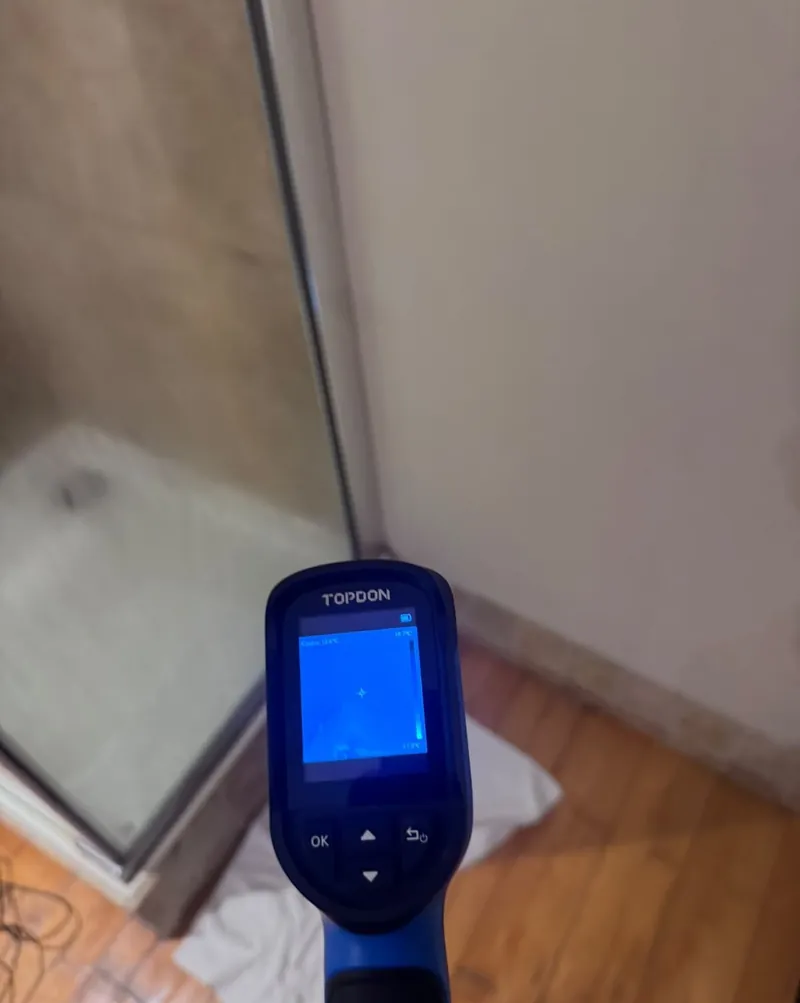
A thermal camera shows surface temperature as colour. Wet areas often look cooler than dry ones, because evaporating water cools a surface, and a hot pipe in a wall can show up as a warm strip. It does not see through a wall and it does not detect water directly. It points to places worth checking with the meter. The image above, a uniform picture of a corner, is an example of what the camera shows when it sees nothing unusual in its field. A flat image does not on its own prove a wall is dry, and a patchy one does not on its own prove a leak.
These are practitioner descriptions of how the instruments behave. Results vary with the material, the age of the damp and the room temperature, which is why we use more than one method and why we say what we could not tell.
We cover the approach in more detail on the moisture mapping and damp diagnosis page and the thermal imaging scan in one hour page.
Safe checks before a visit
These need no tools and do not open anything.
- Note when the damp appears. If it gets worse after rain, outside water is a suspect. If it worsens after showers, look at the bathroom. If it is constant, pipes are more likely.
- Look at nearby taps, radiators, a bath or shower, and a toilet on the other side of the wall. Check for drips, a weeping valve or a stained seal.
- Check for condensation. Wet windows in the morning and mould in cold corners suggest humid air is the cause. Better ventilation helps that, not a pipe repair.
- Do the water meter test: switch off appliances, close the inside stop valve, read the meter, wait 30 minutes and read it again. Thames Water describes this test. If the reading has moved, a leak between the meter and the valve is likely. If it has not, a pipe leak is less likely on the supply, though waste pipes and heating pipes are not tested this way.
- Take dated photographs of the damp, at the same angle each time, so you can see whether it is spreading.
Our page on the water meter leak test walks through it. If the damp is on a ceiling or wall below a bathroom, find a hidden leak in one hour describes the wider first-hour approach.
What we do in the first hour
The first hour costs £100. On a damp wall check a visit often runs like this.
- We ask where the damp is, how long it has been there, what the weather and the water use have done to it, and what has been tried.
- We take moisture meter readings across the wall and compare them with a dry reference area, noting the pattern: a tide mark, a patch, a vertical streak, a corner.
- We scan the area with the thermal camera, along with the pipes, radiators and walls nearby.
- We look at the likely sources next to the damp, including seals, waste connections, window frames, and the other side of the wall where we can reach it.
- We check the supply with a meter test or a pressure test where a pipe is a realistic suspect.
- We tell you what the readings and the pattern suggest, what has been ruled out, what could not be checked, and what we would do next.
The standard rate includes tracer gas, acoustic detection, thermal imaging, an endoscopic camera inspection, a trace and access report for your insurer and a written quote for the remedial works. On a damp wall check the moisture meter and the thermal camera are the main tools. Tracer gas and acoustic methods are held back for cases where the first checks point to a pressurised pipe.
| Outcome | What it means for you |
|---|---|
| Find it | The readings and pattern point to a likely source, such as a seal, a pipe or an outside route. |
| Confirm it | A second method, such as a meter test or a pressure test, agrees with the first, or rules a pipe leak out. |
| Quote the fix | A written quote where the source is a plumbing fault we can repair, or a clear written note if it is not. |
| Sometimes fix it | A simple fault, such as a failed seal or a weeping fitting that is accessible, can sometimes be dealt with in the same visit once the quote is approved. |
When the answer is that it is not a pipe
Sometimes the most useful result of a first hour is that no pipe is leaking. The meter holds, the pressure holds, the thermal image is even and the moisture pattern fits condensation or an outside source. We say that plainly in the written note, and we will not invent a pipe problem to justify a repair.
That does not mean there is nothing to do. Damp from condensation, a roof or gutter fault, a failed window seal or rising damp is usually dealt with by another trade, and we say who. Our case study of a damp bedroom wall that was not a pipe describes a job in London where the finding was that the water did not come from the plumbing. It is a single job, and every building is different.
In older homes, damp can have several contributing causes at once. See water leaks in Victorian and Edwardian London houses for the typical patterns.
What usually needs more than an hour
We would rather tell you now than surprise you later. A damp wall may need longer, or a return visit, when:
- The readings point to a pipe but the wall is tiled, boxed in or fitted with units that hide it.
- The damp is large, or in several rooms, and the source could be anywhere along a run.
- A pressure test shows a drop, and the leak then has to be traced, which can take longer than a first hour.
- The wall is shared with another flat or a neighbour, and the source may be on the other side.
- The damp has been there long enough that the wall is saturated, so readings stay high even after the water is cut off. Drying out takes days or weeks, not an hour.
- The cause looks like roof, gutter, window or ground water, which needs a builder or a roofer, not a leak detection visit.
For the pressure side of a longer investigation, see pressure test pipework in one hour. For how long a full survey takes, see how long does leak detection take.
What it would cost under the pricing
Standard leak detection is £100 for the first hour, then £150 an hour, billed in half hours after the first hour. Everything is included: tracer gas, acoustic detection, thermal imaging, an endoscopic camera inspection, a trace and access report for your insurer and a written quote for the remedial works. No VAT charged, and there is no parking charge.
| Time on site | Total |
|---|---|
| 1 hour | £100 |
| 2 hours | £250 |
| 3 hours | £400 |
These are totals worked out from the rate, not the price of any past job. A typical survey of two and a half to three hours is £325 to £400. We call you before the survey goes past 3 hours. No find, no fee: if a leak is present and we do not find it, you pay nothing.
The repair is separate. If a plumbing fault is found, the repair is quoted in writing with the work set out. We do not publish repair prices on the site because the fix depends on what is behind the wall. See the pricing page for the full rate card.
If a landlord, agent or insurer is involved
A damp wall in a rented flat or a leasehold building usually raises the question of who is responsible. Our report records what was measured, where, and what it does and does not show, with photographs. A careful note that says the source could not be confirmed is more use to a managing agent or an insurer than a confident guess.
We do not say what any landlord or insurer will accept. Read who is responsible for a water leak for how to work out the starting point, and the escape of water claim checklist for what to gather. Check your own policy and lease.
When to call
Call when:
- a wall or ceiling is damp and you cannot tell whether a pipe is involved
- the damp keeps coming back after re-painting or a seal repair
- the meter moves with everything off and the damp is near a bathroom or kitchen
- you need a written finding for a landlord, agent or insurer
Book through report a leak or call 020 3961 5444. We confirm the rate and the time before anyone travels. The wider offer is leak detection for £100 for the first hour, the other jobs are in leak jobs that can be solved in one hour, and the guides cover the rest.
