
What a failing tray edge looks like
A shower tray sits on a frame or on timber, and its edge meets the wall at a sealed joint. When that seal or the grout above it fails, spray runs down behind the tray lip and soaks whatever is underneath. In many older London bathrooms that is a timber floor or a timber upstand, and timber that stays wet for long enough goes soft and dark.
The signs are usually small to begin with. A floor that gives slightly near the tray. Tiles that sound hollow or have lifted at the edge. Black mould along the sealant that returns after cleaning. Skirting board that has swollen next to the shower. A stain on the ceiling below, or a smell in the cupboard next door. By the time the ceiling shows it, water has usually been getting in for a while.
The difficulty is that the same symptoms can come from a supply pipe, a waste joint or a split shower hose, and the wet timber does not tell you which. A rotten edge is the result of a leak. It is not always the source of it. Part of the first hour is working out what is wetting the timber so that the repair is not carried out on the wrong thing.
What you can check yourself
- Press gently along the floor beside the tray with your hand or the flat of a shoe. A spongy or bouncing patch is worth noting. Do not dig at it or try to pull tiles up.
- Look along the sealant between the tray and the wall for gaps, splits or black staining that cleaning does not remove.
- Run the shower for a few minutes with the screen closed, then check whether water appears at the edge, at the corner or on the floor outside.
- Do the meter check with every tap and appliance off, following our guide to the water meter leak test. A meter that does not move points away from a pressurised supply pipe, though it does not rule out a leak that only runs when the shower does.
- Photograph the area with a coin for scale and repeat in a few days. A patch that spreads is useful information.
Do not seal over a suspect gap with fresh silicone before we see it. It can trap water that is already in the structure and hide the evidence. If you suspect water is coming through a ceiling near lights or sockets, stop using the shower and keep clear.
If the waste or trap is the more likely cause, see our page on a waste pipe leak under a shower, which describes the other half of this problem.
What the first hour is for
The first hour costs £100. The aim is to answer two questions: what is wetting the timber, and how far has the wet spread. For most jobs of this kind, depending on access, the hour goes like this.
- A short conversation about what you have noticed, where, and how long the area has been soft or stained.
- A meter and isolation check, so that a pressurised supply pipe is ruled in or out first.
- Moisture readings and thermal imaging around the tray, the wall, the floor and the ceiling below, to map where the wetness is highest.
- A visual look at the tray edge, the sealant and the grout, with a controlled shower test where someone watches the likely entry points.
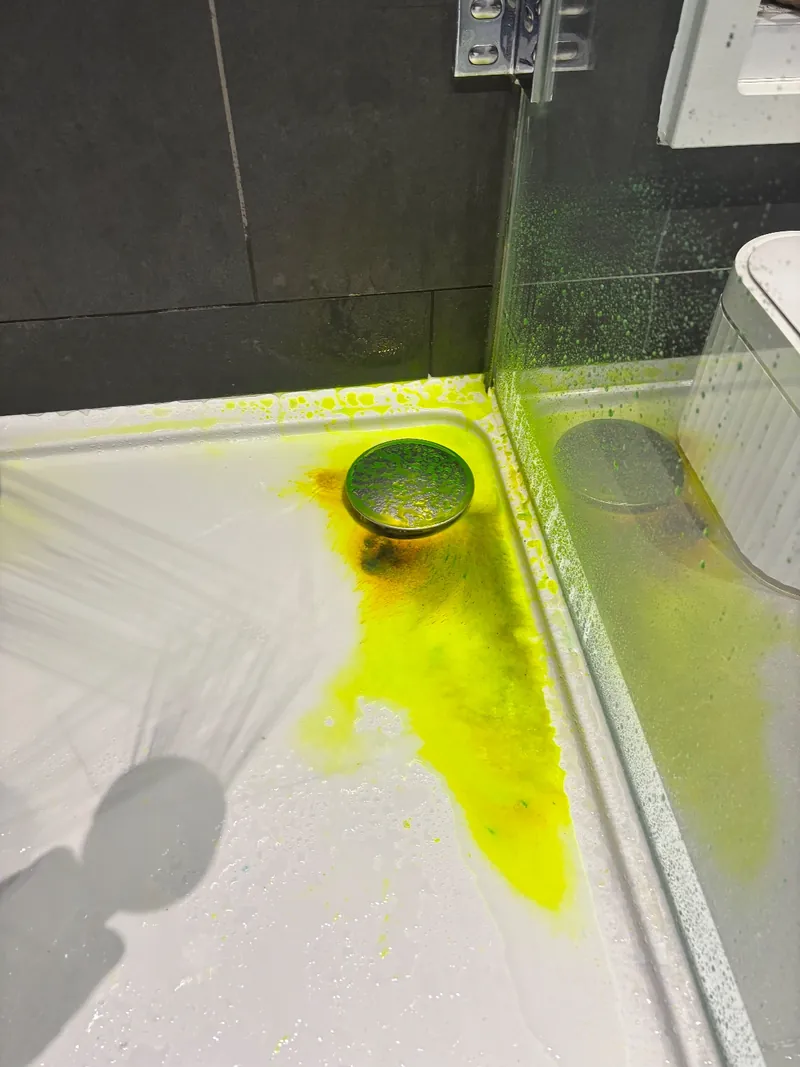
- A dye test where it helps. Coloured water is run at the edge or the grout line, and its route shows whether the entry is the seal, the tile joint or the tray. Our page on the shower tray dye test explains it.
- A camera look through any gap, access panel or opening where there is one, to see the underside of the edge.
The rate includes tracer gas, acoustic detection, thermal imaging, an endoscopic camera inspection, a trace and access report for your insurer and a written quote for the remedial works. Two methods agreeing make a finding, and one reading on its own is a lead. We say which you have. Our guide to non-invasive leak detection describes each method and its limits.
The hour ends with a plain answer on the cause, a note of what is damaged, and a written quote for the work. Because we are plumbers as well as leak specialists, we can usually carry out the repair afterwards if you approve it, though you are free to take the written finding to someone else.
What the rot tells us
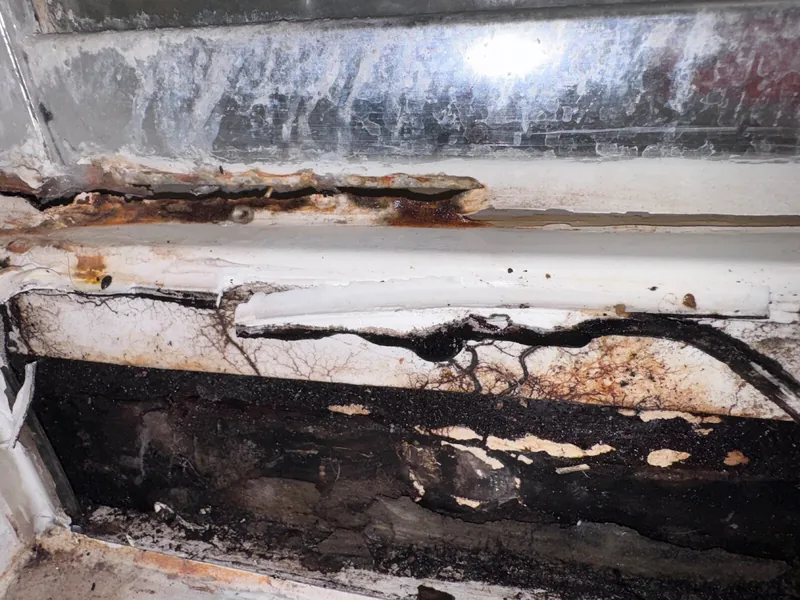
The photograph shows what a long-running edge leak can leave: rusted metal and dark, crumbling timber at the lip of a tray. It is the kind of damage you see when the structure has been going through repeated wetting and drying for a considerable time, not from a single incident. As a practitioner view, that is why a soft floor beside a shower is more often a slow leak than a burst.
It also shows why a first hour should not stop at the edge. Wood that has gone dark is evidence of where water has been. It does not tell you where it came in. A failed sealant line, a cracked grout joint, a loose tray and a weeping waste joint can all end with the same rotten timber, and each one needs a different fix. Replacing the timber and re-sealing the edge without checking the others is a common way for the problem to come back.
It is worth knowing that rot is a question of degree. Timber that is damp and discoloured but still firm may be dried, treated and left. Timber that is soft, crumbles or has lost its fixings needs to be cut out and replaced. We can say from the moisture readings and a probe which of the two you are looking at, but the final call is made once the area is opened and seen.
Where the wet has reached the room below, the damage is a separate issue from the tray. Our case study of a shower waste leak through a flat ceiling shows a related job, and our page on moisture mapping and damp diagnosis explains how we tell a plumbing leak from damp with another cause.
What one hour can and cannot do
| Situation | Often a first hour can | Often needs longer or more access |
|---|---|---|
| Soft floor and failed sealant, tray accessible | Show the entry point with a dye test and quote the repair | Cut out and replace the timber, re-lay the tiles |
| Damp edge, cause unclear | Rule the supply pipe in or out and rank the likely sources | Confirm a waste joint hidden under a fixed tray |
| Stain on the ceiling below | Show whether the wet route runs from the tray edge | Dry out and make good the ceiling |
| Tray loose or cracked | Identify it and quote the replacement | Remove the tray, check the waste and re-fit |
| Several sources at once | Separate the likely causes | Locate and fix each one, which often takes more than an hour |
These are patterns and not a log of past jobs. We do not promise that the cause is found or fixed in one hour. What we can say is that, when the tray edge is visible and the cause is a seal or grout line, the first hour is often enough to find it and write the quote. Replacing rotten timber is usually a separate visit because it involves taking the tray out, cutting, replacing and drying.
A job usually needs longer than an hour when the damage runs further than the visible edge, when the wet has reached the room below, when the cause is more than one thing, or when the area has to dry before it can be rebuilt. If you need a written record for an insurer, see leak detection report for an insurance claim.
What it would cost under the pricing
Standard leak detection is £100 for the first hour, then £150 an hour, billed in half hours after the first hour, with everything included: tracer gas, acoustic detection, thermal imaging, an endoscopic camera inspection, a trace and access report for your insurer and a written quote for the remedial works. No VAT charged, and there is no parking charge. If the first hour answers the question, the survey part is £100.
| Time on site | Total |
|---|---|
| 1 hour | £100 |
| 2 hours | £250 |
| 3 hours | £400 |
A typical 2.5 to 3 hour survey is £325 to £400, which is the realistic expectation when the damage is spread or the cause is not obvious. These figures are worked out from the rate, not taken from past jobs, and they are a guide, not a cap. We call you before the survey goes past 3 hours, so you decide whether to go on. A leak on the buried supply pipe is a different job at a fixed £450, however long the job takes.
Repairs are not in these prices. Cutting out and replacing timber, resealing and re-tiling are quoted separately in writing after the cause is known. No find, no fee: if a leak is present and we do not find it, you pay nothing. The full rate card is on the pricing page.
When to call
- the floor beside the shower feels soft or springy
- sealant keeps going black or splitting at the tray edge
- tiles have lifted or sound hollow near the tray
- a stain has appeared on the ceiling below the bathroom
- you are about to have the tray replaced and want to know the cause first
Book through report a leak or call 020 3961 5444, and we confirm the rate and the time before anyone travels. The wider offer is leak detection for £100 for the first hour, the other jobs of this kind are on leak jobs that can be solved in one hour, and the guides cover the background.
