

What a flexi hose is and how it leaks
A flexi hose, also called a flexible tap connector, is the short braided or ribbed hose that links the pipe on the wall to a tap or a cistern. You will find them under most kitchen sinks, bathroom basins and toilet cisterns. They bend, so a tap can be fitted without a precise pipe run, which is why plumbers use them so widely.
They also leak. There are two common places. One is the hose itself, where the inner lining can split or the braid can corrode and weep. The other is a connection at either end, where a nut or washer has loosened, perished or never seated properly. A pinhole at the crimp is a third, rarer, case. Which of these you have decides the fix.
This is a practitioner description of how the fitting tends to fail, not a rule, and it is not a statement about how often it happens. A leaking hose can be slow and quiet, and a slow leak under a sink is often found only when a cupboard base swells or a smell appears.
Safe checks you can do first
- Empty the cupboard under the sink or basin so you can see the pipes. Put a bowl or towel under the area if water is still dripping.
- Dry the hoses and connections with a paper towel, then watch. The place where a fresh bead of water forms tells you more than a damp patch.
- Run a paper towel along the length of each hose and each nut. A wet streak on the towel points to the exact spot.
- Note whether it leaks all the time, or only when the tap is on, or only when the cold or hot is running. A leak that only appears when the tap is open points to the hose after the tap valve. One that leaks all the time points to the supply side.
- Look at the cupboard base and the wall behind. Swelling, staining or a musty smell means water has been escaping for a while.
If water is escaping steadily, close the small isolation valve on the pipe feeding that hose, a slot-headed valve that turns a quarter turn. Do not force a stiff one. If it will not close, turn off the inside stop valve, which Thames Water says is usually under the kitchen sink, and read how to turn off your mains water or where the stopcock is in a house.
Do not over-tighten a connection to stop a drip. Tightening a nut that has a damaged washer can make the leak worse or split the fitting. Isolate the water and call.
What we do in the first hour
The first hour costs £100. On a leaking flexi hose it often runs like this.
- We ask when you first saw water, and which tap or fitting is above it.
- We dry the connections and watch for the first bead to form, so we know whether it is the hose, a nut or the isolation valve.
- We check the isolation valves and test whether they close, because a valve that will not close changes the job.
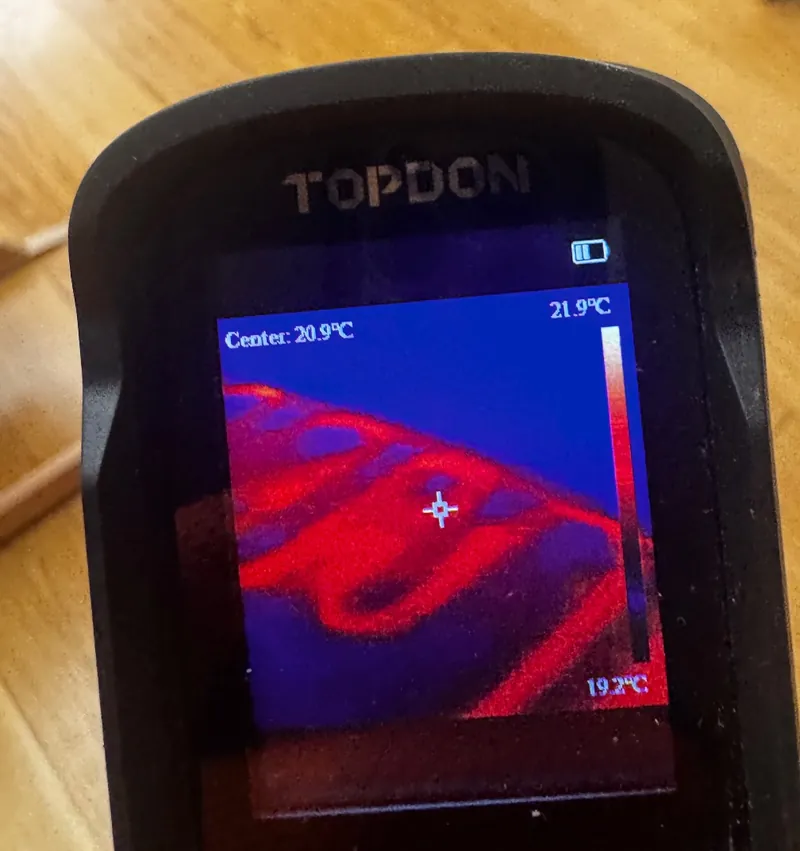
- We read moisture across the cupboard base, the back panel and the wall, with thermal imaging where the surface warrants it, so the extent of the damp is on record before anything is replaced.
- We tell you what failed, whether neighbouring hoses are the same age and type, and give a written quote for the repair.
Many sinks have two or three hoses of the same type and age. If one has failed, the others may be near the same point. We say so and quote the option of replacing them together, so you can decide.
The rate includes tracer gas, acoustic detection, thermal imaging, an endoscopic camera inspection, a trace and access report for your insurer and a written quote for the remedial works. A leaking hose rarely needs tracer gas. The moisture meter and the thermal camera are more likely to be used, particularly if the leak has been running for some time.
What usually needs more than an hour
- The isolation valves do not close, or are missing, so the supply to the fitting cannot be isolated on its own.
- The hose is behind a panel, a bath surround or a built-in unit, and getting to it means taking something apart.
- Water has already travelled, and the damp is under a floor or in the ceiling below.
- The hose is only one of several leaks, and the meter keeps moving when it is isolated.
- The connection is fused to a tap that is old or corroded, so the repair becomes a tap replacement.
If the hose is on a washing machine or dishwasher, the fitting and the risk are a little different. See washing machine hose leaks and prevention. If the damp has spread, moisture mapping and damp diagnosis explains how we map it, and find a hidden leak in one hour covers the first hour of a wider search.
If a leak has been running into a cupboard or floor, it may matter for an insurance claim. See does home insurance cover water leaks. Whether an insurer pays is its decision, and wording differs by policy.
What it would cost under the pricing
Standard leak detection is £100 for the first hour, then £150 an hour, billed in half hours after the first hour. No VAT charged, and there is no parking charge. If the hose is clearly the source and the visit stays inside the first hour, the survey part is £100.
| Time on site | Total |
|---|---|
| 1 hour | £100 |
| 1.5 hours | 175 pounds |
| 2 hours | £250 |
| 3 hours | £400 |
These totals are worked out from the rate. They are not the price of any past job. The repair is not in them. New hoses, new isolation valves or a new tap are quoted separately in writing, with the parts and the work set out. We do not publish repair prices because every fix is different.
We call you before the survey goes past 3 hours. The full rate card is on the pricing page.
When to call
- water is coming from a hose or a connection and you cannot isolate it
- the cupboard base is swollen, stained or smells musty
- you have tightened a nut and the leak continues
- there is a stain on the ceiling below a kitchen or bathroom
- you manage or let the property and need a written finding, see leak prevention for flats and managing agents
Book through report a leak or call 020 3961 5444. We confirm the rate and the time before anyone travels. The wider offer is leak detection for £100 for the first hour, and the other one hour jobs are on leak jobs that can be solved in one hour. The guides cover the questions around it.
A note on workmanship
The Water Supply (Water Fittings) Regulations 1999 say that repairs to water fittings should be done in a workmanlike way, to a relevant British Standard or another recognised method. A like-for-like leak repair is not among the works listed in the regulations as needing prior notice to the water company, in the text we read. Check the current version on legislation.gov.uk if it matters for a tenancy or a sale.
Thames Water's repair page says to ask for a certificate of water regulations compliance after the work, and recommends a WaterSafe-listed contractor for visible leaks. We are an independent leak detection and plumbing company and are not on that register, and we say so plainly. If a compliance certificate matters for your situation, tell us before you book.
Choosing what goes back in
Once the failed hose is identified, the repair is usually one of three things. The first is a new hose of the same length and connector type, which suits a tap and valves that are otherwise sound. The second is a new hose with new isolation valves, which suits a sink where the valve is stiff, weeping or missing. The third is a new tap with new hoses, which suits an old or corroded tap.
Which one makes sense is a judgement about the whole fitting, and it is the engineer's to give in the written quote. As a practitioner view, a hose is worth replacing when it is stained, kinked, crusted at the ends or the same age as one that has just failed. A hose that is dry, flexible and clean is less likely to be the problem.
Ask for the quote to list each item, so you can see what is a part, what is a valve and what is labour. You are not obliged to accept it. The report and the quote are yours, and a different plumber can work from them. That is the reason the survey and the repair are priced separately: it keeps the finding honest.
If you let the property, ask whether the hose is something the tenancy or the lease puts on you or on the landlord. Under section 11 of the Landlord and Tenant Act 1985 a landlord must keep the installations for water supply and sanitation in working order in covered tenancies, which GOV.UK describes as including pipes and sanitary fittings. Check your tenancy, because the details depend on the agreement.
