Whose pipe is under the driveway?
Start with ownership, because it decides who you ring. Thames Water’s own page on pipe responsibility says the water company looks after the water mains and the “communication pipe” that links your supply pipe to the main. You look after the supply pipe from your property boundary into your home, which it describes as usually running under private land such as a garden or driveway. Everything inside the building is yours too.
So for a typical house with a front drive, the pipe under the drive is the owner’s. If you rent, the landlord is the person to tell, ideally in writing. If your supply is shared with neighbours, which is common on London terraces, each owner looks after the part that serves only their home and the owners share the common section. Thames Water says it does not step into disputes between neighbours. We cover the sharing question properly in who owns the water supply pipe.
Signs of a leak under a driveway
Underground water does not always come up where the pipe is broken. It follows the path of least resistance through the bedding sand and the gaps around the pipe, so the symptom can show up several metres from the fault. These are the signs worth taking seriously, starting with the ones Thames Water lists on its own leak-identification page.
- Damp patches, puddles or green, soft ground beside the drive during dry weather.
- Cracks in paving, block paving that has dipped or sunk, or tarmac that has started to break up.
- A pothole or small sinkhole appearing in or beside the drive.
- Noticeably lower water pressure than usual, or taps that run weakly at certain times.
- Dirt, discolouration or air in the water.
- A rise in your bill or meter use that you cannot explain, if you have a meter.
Confirm it with the meter, not with a spade
If you have a water meter, it will tell you whether water is leaving the system when nothing should be using it. Thames Water’s published method is below. It was read on 24 November 2026, so check the page itself before relying on the wording.
- Turn off everything that uses water: taps, dishwasher, washing machine, and make sure no toilet cistern is refilling. Check that no one is in the shower.
- Close your inside stop valve, which is usually under the kitchen sink. Turn it clockwise and do not force it (more on that in how to turn off your mains water).
- Read the meter and write the numbers down, including any red digits or dials.
- Wait 30 minutes without using any water.
- Read it again. If the reading has not moved, there is no leak between the meter and the inside stop valve. If it has moved, Thames Water says the leak is between the meter and the inside stop valve.
That last sentence is the useful one for a driveway. With the inside stop valve shut, nothing in the house can be drawing water, so any movement means water is escaping on the supply pipe, which is exactly the section that runs under the drive. Many meters also have a small leak indicator, often a little spinning triangle or star, that turns when any flow passes. If it is turning with every tap off and the inside valve closed, treat that as a positive result.
A meter that stays still does not rule out a very small leak, because some meters do not register a trickle in a short test, and it says nothing if you are unmetered. Repeat the test overnight if you are unsure, reading the meter last thing at night and first thing in the morning without using any water in between. The full routine, with the reading and the arithmetic, is in how to do a water meter leak test, and if you are not sure where the meter is, read where is my water meter.
What to check yourself, safely
There is a useful amount you can do without a tool beyond a torch. The aim is to narrow the cause and protect the property while you wait for help.
- Look at the wet area at the same time every day and photograph it with something for scale. Dated photos help later with a leak allowance request or an insurer.
- Check the meter box for water. A meter chamber that is full or damp can mean a leak at the meter itself, which is a different problem; see water meter box leaking or full of water.
- If water is pooling near outdoor sockets, a garage consumer unit or a charger, switch the power off at the consumer unit before going near it, and do not touch wet electrical equipment.
If the leak is large, or the house is losing pressure, close the inside stop valve and leave it closed until it is dealt with. Your cold taps will stop within a few minutes. Hot water from the cylinder may still run for a while, and switch off any immersion heater or boiler that depends on a refilling system if it cannot refill. If you cannot find or turn the inside valve, our guide on the stop tap lists the fallbacks, including the outside stop tap, which Thames Water describes as for emergencies and which will shut off a shared neighbour too.
What not to do
- Do not start digging. Under a drive there can be a water pipe, a gas pipe, electric and telephone cables, a drain and old services nobody remembers. A spade or mini digger through a live cable or a gas pipe is a serious injury risk, and the leak is rarely where the wet patch is.
- Do not lift block paving or break tarmac and concrete to “have a look”. You will pay to reinstate the surface whether or not you find the pipe, and a large hole makes the later survey harder, not easier.
- Do not pour acid, descaler, drain chemicals or “leak sealer” down a stop tap or into the ground. They damage pipes and fittings and can harm the soil, and a sealer will not repair a split in a buried supply pipe.
- Do not cut into, clamp or splice a pipe you have not identified. You may be on the wrong pipe, and a bad joint on a supply pipe can leave you with a bigger fault than the one you started with.
- Do not leave a known leak for months. Thames Water’s page on arranging repairs says a confirmed leak on your property should be repaired within four weeks of you finding it or being told about it, and it says a metered customer can lose the leak cover on their bill if a formal notice is ignored.
Where the pipe runs under a drive
There is no standard route, but there is a usual pattern. The supply pipe leaves the water company’s pipe at or near the boundary, often close to the outside stop tap and meter, and goes in a more or less straight line to the house, commonly to the kitchen or an under-stairs cupboard where the inside stop valve is. Older properties, and houses that were once one building and are now flats, can have a supply pipe that wanders, doubles back or serves a neighbour as well. How deep it lies is covered in how deep is a water supply pipe in the UK, and where does my water supply pipe run goes through the route in more detail.
How a leak under a drive is found
Several methods exist and none is magic. A good survey combines two or three and says plainly when the result is a probable area rather than a certain point.
| Method | What it does | Where it struggles |
|---|---|---|
| Pipe tracing | Follows the route of the pipe with an electronic locator, a trace wire or a probe pushed along it, so the search area is a line rather than the whole drive. | Plastic pipe with no tracer wire. Pipes bent or joined in odd places. Heavy interference from other buried metal. |
| Acoustic listening and correlation | Microphones on the stop tap, the meter and the ground, listening for the sound of water escaping. Two contact points can be compared to estimate the position between them. | Traffic, plant and wind noise. Plastic pipes carry the sound poorly, so readings are shorter-range. Very small leaks make little noise. |
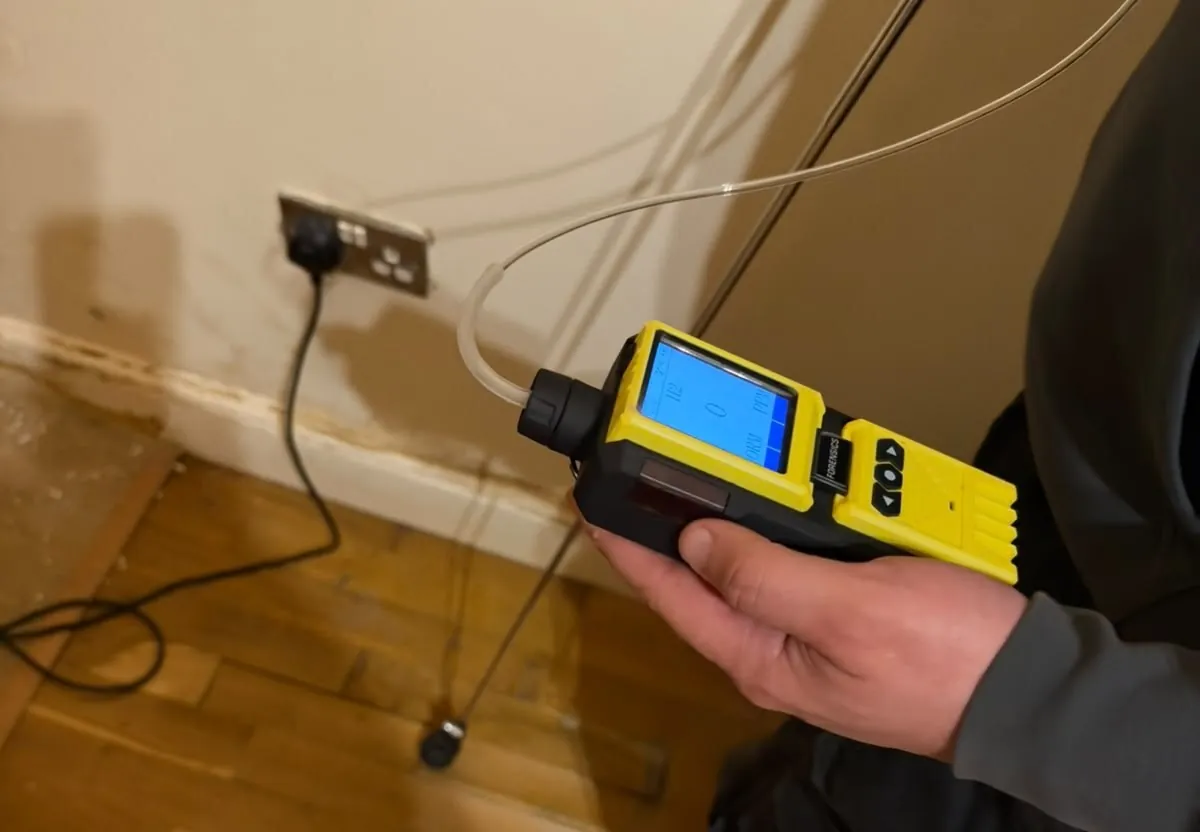
| Tracer gas | A safe, non-flammable mix of hydrogen and nitrogen is put into the isolated pipe. It escapes at the leak, rises through the ground and is picked up at the surface by a sensitive detector. | Dense concrete or tarmac slows the gas, so small access holes may be needed. Very wet or waterlogged ground and a pipe that cannot be isolated are harder. |
| Thermal imaging | A thermal camera shows temperature differences. Useful for hot supply and heating pipes, and for damp patches that are a different temperature. | Cold mains water under thick paving often gives little contrast. It is a support method here, not the main one. |
Details of how a typical visit runs, from isolating the pipe to the final marking, are in leak detection: what happens on the day. The service page for this work is underground supply pipe leak: trace and repair.
What tracing a leak under a driveway costs
Mains and supply-pipe tracing is charged at £180/hr, quoted before we start. A typical visit comes to £360 to £540, depending on the length of the run, how easy the pipe is to isolate and how many methods are needed. If tracer gas is used it is charged at the same hourly rate, plus a one-off bottle charge of £80 when it is needed. No VAT charged.
That is the cost of finding the leak. Repairing it is quoted separately, once the position is known, because a short patch repair and a full pipe replacement are different jobs. Reinstating the drive surface, whether that is relaying block paving or patching tarmac, is part of the repair quote rather than the survey. See leak detection prices for the full table and how we price and where our figures come from.
To get a figure that fits your drive, report a leak with a few lines on what you have seen, or ring 020 3961 5444.
Us, a plumber or the water company?
- Ring Thames Water, or report it on their report-a-problem page, if the water is coming up in the road or pavement, if the leak is clearly on the main or on the water company’s side of the boundary, or if there is no water or very low pressure across the street.
- Call a leak specialist if the leak is on your supply pipe and you cannot see where, which is the typical drive case. A plumber can often repair a pipe but may be unable to find a leak outside the home, a point Thames Water makes itself.
- Call a plumber straight away if the leak is inside the house, at the meter outlet or at a visible fitting.
- Tell your insurer early. Thames Water advises checking your home emergency or buildings insurance before you arrange repair, because some policies cover supply pipe leaks. Cover differs by insurer, so read your policy wording; see does home insurance cover water leaks.
Thames Water recommends a WaterSafe approved contractor for hidden or outside leaks. Plainly: we are an independent leak detection and plumbing company, we are not Thames Water, and we are not on the WaterSafe register. You are free to use any competent contractor. Whoever does the repair, ask for a certificate of water regulations compliance afterwards, which is what Thames Water says to get.
If Thames Water has told you the leak is yours, the four-week period starts from when it told you or you found it. Do not wait for a formal notice. For the allowance side, our leak allowance evidence checklist lists what to keep.
After the leak is found
Once the position is marked, the options are usually one of three. A spot repair means opening a small area, cutting out the damaged section and joining in a new piece, which suits a single split or a failed joint on otherwise sound pipe. Replacement means laying a new run, either by digging a trench or by pulling a new pipe through the old route with a moling tool. Re-routing is occasionally the answer when the old route runs under an extension or a tree.
Which one fits depends on the pipe’s age and material, how many faults it has had, and how much of the drive would be lifted. The trade-off between digging and moling is set out in moling or digging: replacing a water supply pipe, and water supply pipe: repair or replace helps with the decision. Our own page on water supply pipe replacement covers what a replacement involves.