

The problem
A tenant in a house in Waltham Forest received a letter from the water company. It said the meter suggested continuous water loss at the property, estimated at about 10 litres an hour. The tenant wanted to know whether the leak was inside the house or on the supply coming in.
The tenant also mentioned that the incoming pipe had been renewed about five years earlier, with the old lead pipe replaced by 25 mm plastic. That detail matters, because a new pipe does not rule out a leak at a joint or a connection, and connections are where leaks like this often sit.
We are an independent firm and have no link with any water company. This page describes our own visit and does not speak for any water company. If you get a letter like this, the question of who is responsible for which section of pipe is covered on our mains water leak who is responsible page, and you should check the current position with your own supplier.
What we checked
We began outside, because that is where the evidence for a supply leak tends to be. The driveway and the area around the incoming supply were inspected for raised or bubbling paving, standing water, damp patches or anything surfacing. There was nothing. That fits with the letter: a leak of this size may never come to the surface.

Then came the tracer gas test. To make it, the cold water system was drained down, the relevant pipe was cut into and isolated, and the section between the internal stopcock and the external stopcock and meter connection was capped to make a closed test section. Tracer gas was introduced into that section under controlled conditions.
- Walk the inside of the property with the detector, checking for gas escaping from internal pipework.
- Take the detector outside and check the driveway and the line of the supply.
- Pay attention to the meter, where the supply connects.
- Refill with water and check again under normal supply conditions.
Inside, there was no sign of gas. The pipework within the house was not the problem. That alone cut the search in half. For more on how tracer gas is used on a supply pipe, see supply pipe leak trace and repair.
What we found
Outside, the equipment began to respond around the external water meter. Gas was escaping at the meter connection. There were visible air bubbles in the ground around the meter, and a gas escape could be heard at the same spot. Three separate signs, one location.

We did not stop there. Once the gas was cleared, the supply was refilled with water. Water was then seen bubbling up from the ground around the meter connection, with a gurgling sound from the same area. That second test used no gas at all, and it gave the same answer.
So the leak was at the connection to the external water meter. The initial look at the driveway had given no clue. The meter chamber is a small, easily overlooked place, and it is also a place where the question of ownership gets awkward, which is why the next section is worth reading.
What we did on the visit
The job was a detection visit, and the job record ends with the location of the leak established and the findings written up. It does not record a repair on the day, so we do not describe one. What a reader needs from this stage is the location, the evidence and a written report, because those are what decide what happens next.
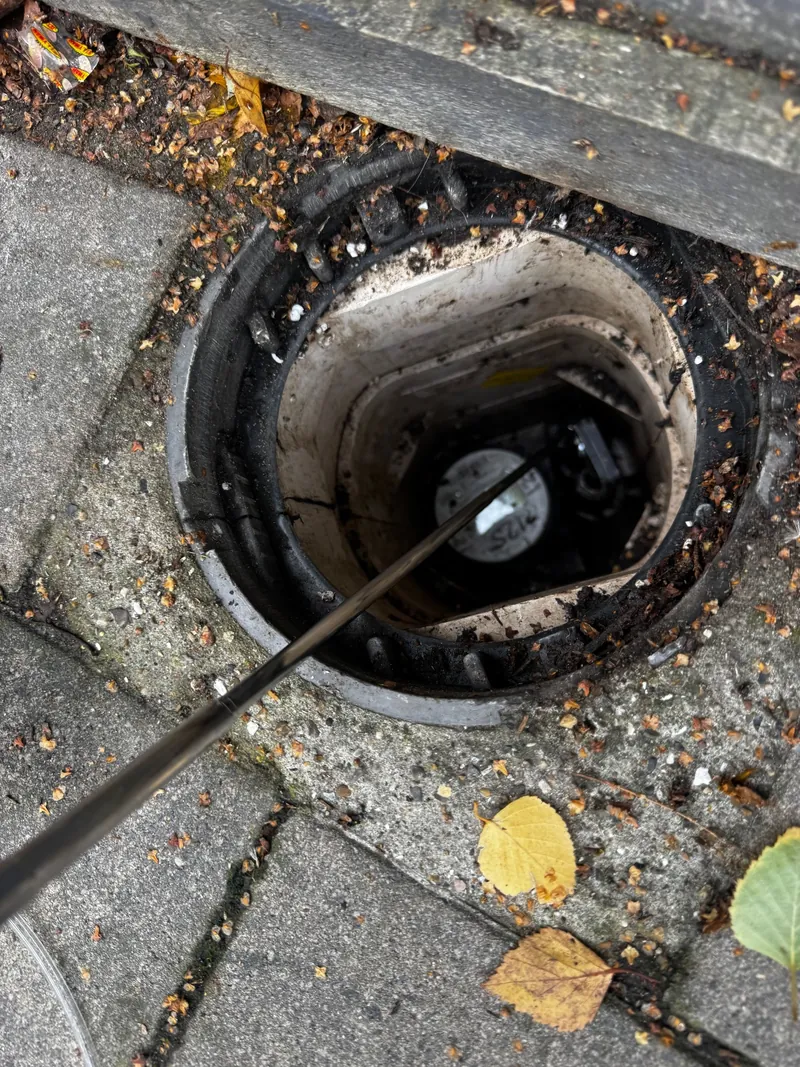
What happens next depends on whose pipe it is. A leak at a meter connection sits near the boundary between what the water company looks after and what the property owner does, and we do not decide that for you. Our pages on the water meter box leaking or full of water and who owns the water supply pipe set out the questions to ask. Check the current position with your supplier before you pay for any repair.
The record gives no duration for the visit, and this one involved draining down and cutting in, so we make no claim that it was quick. It is here as an example of mains work, not of a one hour job.
What a visit like this costs under our pricing
We are not reprinting what this customer paid, and none of this is a quote for your property. Mains and supply pipe leak detection is a different product from standard detection, and it is priced differently.
Mains and supply pipe leak detection is a fixed £450, however long the job takes. That is one price, so you know the cost of the detection before it starts. Everything included: tracer gas, acoustic, thermal imaging, camera inspection, insurer report and a written repair quote, no parking charge
- tracer gas, acoustic detection, thermal imaging, an endoscopic camera inspection, a trace and access report for your insurer and a written quote for the remedial works
- No VAT charged
- No find, no fee: if a leak is present and we do not find it, you pay nothing
For a smaller job inside the property, standard detection is £100 for the first hour, then £150 an hour, and a typical survey is £325 to £400. Repairs are quoted in writing after the leak is found, and never priced on this site. See the pricing page.
What to take from this
- A letter about water loss does not tell you where the water is going. Test the supply before you start pulling up the house.
- No damp patch on the driveway does not mean no leak. A small loss may never reach the surface.
- A renewed pipe can still leak at a joint or connection.
- Use two methods when you can. Here, gas located the leak and a water test confirmed it.
- Before you pay anyone for a repair, find out who is responsible for the section of pipe, and read our guide to leaks under a driveway if the pipe runs beneath one.
If you have a letter like this one, report the leak and we will tell you what a visit would involve. The guides hub has more.
